Ullmann Coupling
Cu-catalyzed C–N/C–O/C–S coupling (the Ullmann condensation / Goldberg reaction)
What is the Ullmann Coupling?
The Ullmann coupling — often called the Ullmann condensation, or the Goldberg reaction when the nucleophile is an amide — is a copper-catalyzed method for forming C–N, C–O, and C–S bonds between an aryl halide and a nitrogen, oxygen, or sulfur nucleophile. It predates the Buchwald-Hartwig amination by roughly a century and remains attractive today precisely because copper is far cheaper and less toxic than palladium.
Classical Ullmann conditions demanded harsh temperatures and stoichiometric copper, but the introduction of chelating ligands — diamines, phenanthrolines, amino acids — dramatically accelerated the catalytic cycle, bringing reaction temperatures down and copper loadings to catalytic levels. Modern ligand-accelerated Ullmann-type couplings are now a genuine complement to Buchwald-Hartwig chemistry, especially at industrial scale where copper's lower cost and toxicity are significant advantages.
Reaction schemes


Catalytic cycle
Ar–Cu formation
Cu(I) reacts with the aryl halide, generating an aryl-copper species (by oxidative addition/reductive elimination on copper or a related pathway).
Ligand exchange
The N-, O-, or S-nucleophile, deprotonated by base, coordinates to copper.
C–heteroatom bond formation
Reductive elimination delivers the new C–N, C–O, or C–S bond and regenerates active Cu(I).
Applications
- Lower-cost, lower-toxicity alternative to Buchwald-Hartwig amination at scale.
- Diaryl ether and diaryl sulfide synthesis (Ullmann/Goldberg-type O- and S-arylation).
- Heteroaryl amine synthesis for pharmaceutical building blocks.
Worked examples
Every example below — reagents, conditions, and literature source — is reproduced from Cross-Coupling Reactions: Mechanisms and Examples by Marcos San Segundo, PhD.


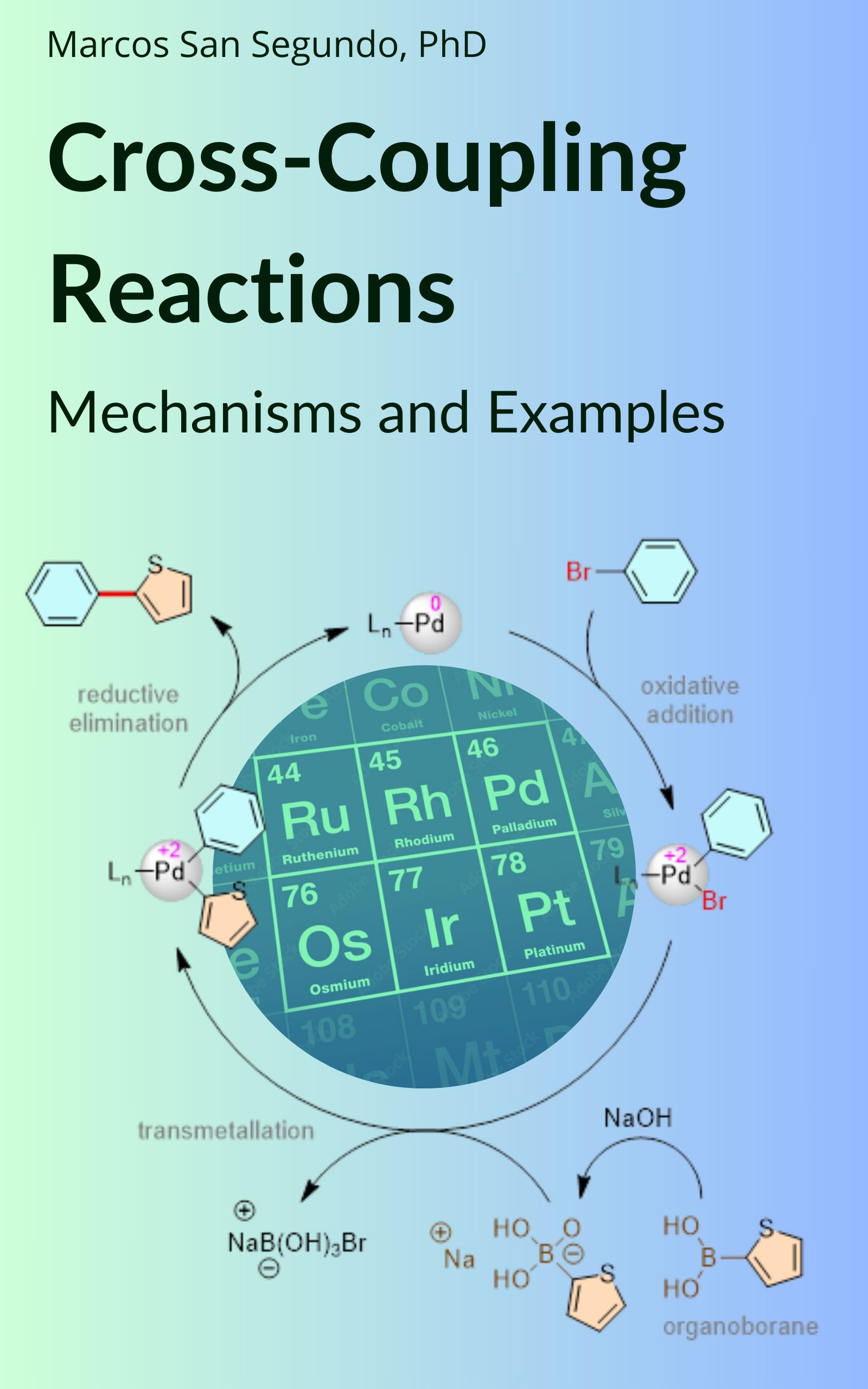
Cross-Coupling Reactions: Mechanisms and Examples
This page covers the Ullmann Coupling — one of 21 named reactions in the book, each with its full catalytic cycle and every worked example shown here, drawn straight from the primary literature.