Nozaki-Hiyama-Kishi Cross-Coupling
Cr-mediated, Ni/Pd-catalyzed addition of organohalides to aldehydes
What is the Nozaki-Hiyama-Kishi Cross-Coupling?
The Nozaki-Hiyama-Kishi (NHK) coupling adds a vinyl, aryl, or allyl halide to an aldehyde to form a new C–C bond and an allylic or homoallylic alcohol, mediated by chromium(II) and, in most modern protocols, a catalytic nickel or palladium co-catalyst that activates the organohalide. It is prized for exceptional chemoselectivity: the organochromium intermediate reacts with aldehydes but leaves ketones, esters, and many other electrophiles untouched, and the reaction runs at room temperature under essentially neutral conditions.
The original protocol required a full stoichiometric equivalent of toxic chromium(II) salts, which limited its use at scale. Catalytic variants that regenerate Cr(II) in situ — typically with manganese metal or a silyl chloride as the terminal reductant — have made NHK couplings far more practical while keeping the reaction's signature mildness and selectivity. It remains a favorite in complex natural product total synthesis, notably in Kishi's own work on marine polyether toxins.
Reaction schemes


Catalytic cycle
Ni/Pd oxidative addition
A catalytic Ni(0) or Pd(0) species inserts into the C–X bond of the vinyl/aryl/allyl halide.
Transmetalation to chromium
The organometallic intermediate transfers its organic group to Cr(III)/Cr(II), generating a nucleophilic organochromium species.
Nucleophilic addition to the aldehyde
The organochromium reagent adds to the aldehyde through a chair-like transition state, giving the alcohol product; Mn(0) (or another reductant) regenerates Cr(II) for turnover.
Applications
- Stereoselective fragment-coupling in complex natural product total synthesis.
- Chemoselective C–C bond formation on substrates carrying ketones or esters that must survive.
- Asymmetric variants using chiral sulfonamide or salen-type ligands on chromium.
Worked examples
Every example below — reagents, conditions, and literature source — is reproduced from Cross-Coupling Reactions: Mechanisms and Examples by Marcos San Segundo, PhD.
An asymmetric Nozaki-Hiyama-Kishi coupling.


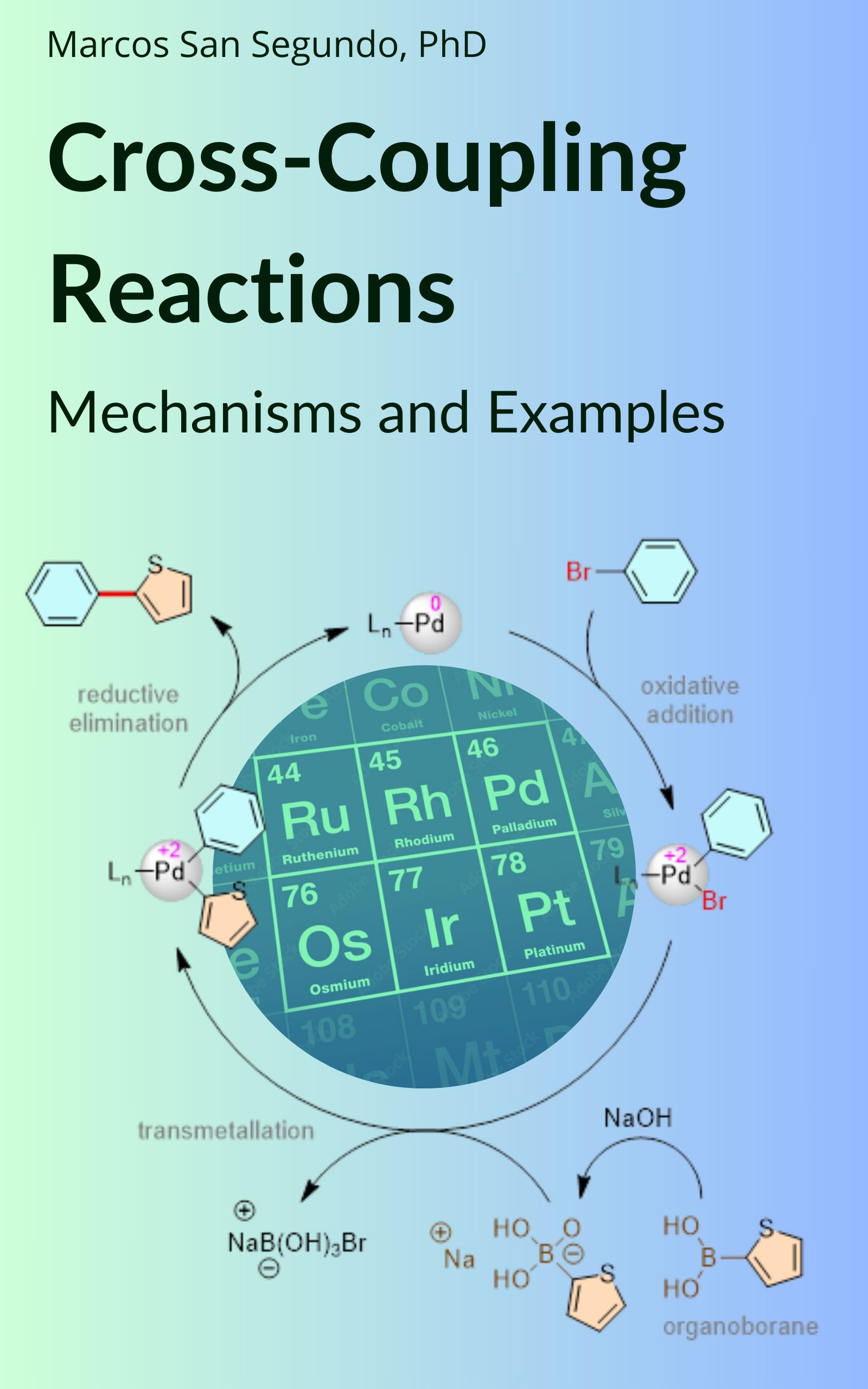
Cross-Coupling Reactions: Mechanisms and Examples
This page covers the Nozaki-Hiyama-Kishi Cross-Coupling — one of 21 named reactions in the book, each with its full catalytic cycle and every worked example shown here, drawn straight from the primary literature.