Suzuki Cross-Coupling
Pd-catalyzed coupling of boronic acids/esters — the most widely used cross-coupling
What is the Suzuki Cross-Coupling?
The Suzuki cross-coupling — also widely known as the Suzuki-Miyaura coupling — joins an aryl or vinyl boronic acid (or boronate ester) with an aryl or vinyl halide under palladium catalysis and base. It has become the single most widely used carbon–carbon bond-forming reaction in the pharmaceutical industry, largely because boronic acids are commercially abundant, bench-stable, low in toxicity, and tolerant of water — none of which is true of the tin or zinc reagents used in the closely related Stille and Negishi couplings.
Base plays a dual role in the mechanism: it can activate the boronic acid toward transmetalation by forming a more nucleophilic boronate ('ate' complex), or it can convert the halopalladium(II) intermediate to a hydroxo- or alkoxo-palladium species that transmetalates more readily — both pathways are supported in the literature, and which one dominates depends on the specific base and conditions used. Akira Suzuki shared the 2010 Nobel Prize in Chemistry for this work, together with Ei-ichi Negishi and Richard Heck.
Reaction schemes


Catalytic cycle
Oxidative addition
Pd(0) inserts into the Ar–X bond of the aryl or vinyl halide.
Transmetalation
Base activates the boronic acid (or the Pd–X bond) so the aryl group transfers from boron to palladium.
Reductive elimination
The new C(sp2)–C(sp2) bond forms and Pd(0) is regenerated.
Applications
- The default method for biaryl bond formation in drug discovery and process chemistry.
- Compatible with aqueous conditions and a very broad functional-group tolerance.
- Feeds directly from Miyaura borylation in one-pot borylation/coupling sequences.
Worked examples
Every example below — reagents, conditions, and literature source — is reproduced from Cross-Coupling Reactions: Mechanisms and Examples by Marcos San Segundo, PhD.


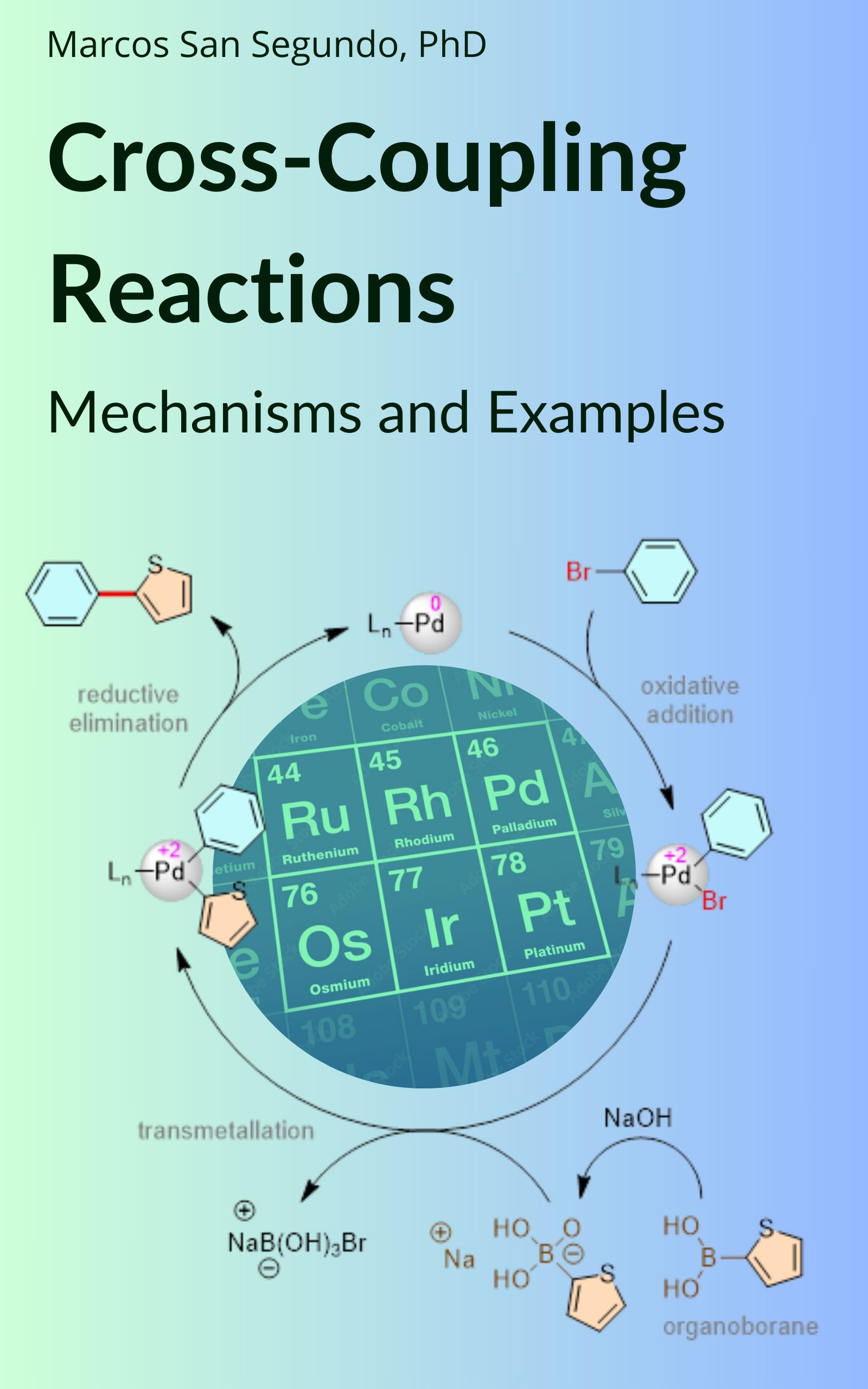
Cross-Coupling Reactions: Mechanisms and Examples
This page covers the Suzuki Cross-Coupling — one of 21 named reactions in the book, each with its full catalytic cycle and every worked example shown here, drawn straight from the primary literature.