Fukuyama Cross-Coupling
Pd-catalyzed ketone synthesis from thioesters and organozincs
What is the Fukuyama Cross-Coupling?
The Fukuyama cross-coupling converts a thioester into a ketone by coupling it with an organozinc reagent under palladium catalysis. Thioesters are far more reactive toward oxidative addition than ordinary esters because the C–S bond is weaker and more polarizable than C–O, so palladium can insert selectively into the acyl–sulfur bond while leaving other esters and functional groups on the molecule untouched.
That selectivity is the whole point of the method: it gives direct, one-step access to ketones from acyl precursors under conditions mild enough to survive alongside acid-, base-, or reduction-sensitive functionality — a real advantage over adding organolithiums or Grignards to esters, which tend to over-add and stop at the tertiary alcohol rather than the ketone.
Reaction schemes


Catalytic cycle
Oxidative addition
Pd(0) inserts into the C(acyl)–S bond of the thioester, assisted by a thiophilic copper(I) additive that helps abstract the thiolate.
Transmetalation
The organozinc reagent transfers its organic group to the acyl-palladium(II) intermediate.
Reductive elimination
C–C bond formation releases the ketone and regenerates Pd(0).
Applications
- Chemoselective ketone synthesis on complex, densely functionalized intermediates.
- Late-stage modification of amino-acid-derived building blocks (e.g., phenylalanine derivatives).
- An alternative to Weinreb amide chemistry for controlled, single-addition ketone formation.
Worked examples
Every example below — reagents, conditions, and literature source — is reproduced from Cross-Coupling Reactions: Mechanisms and Examples by Marcos San Segundo, PhD.


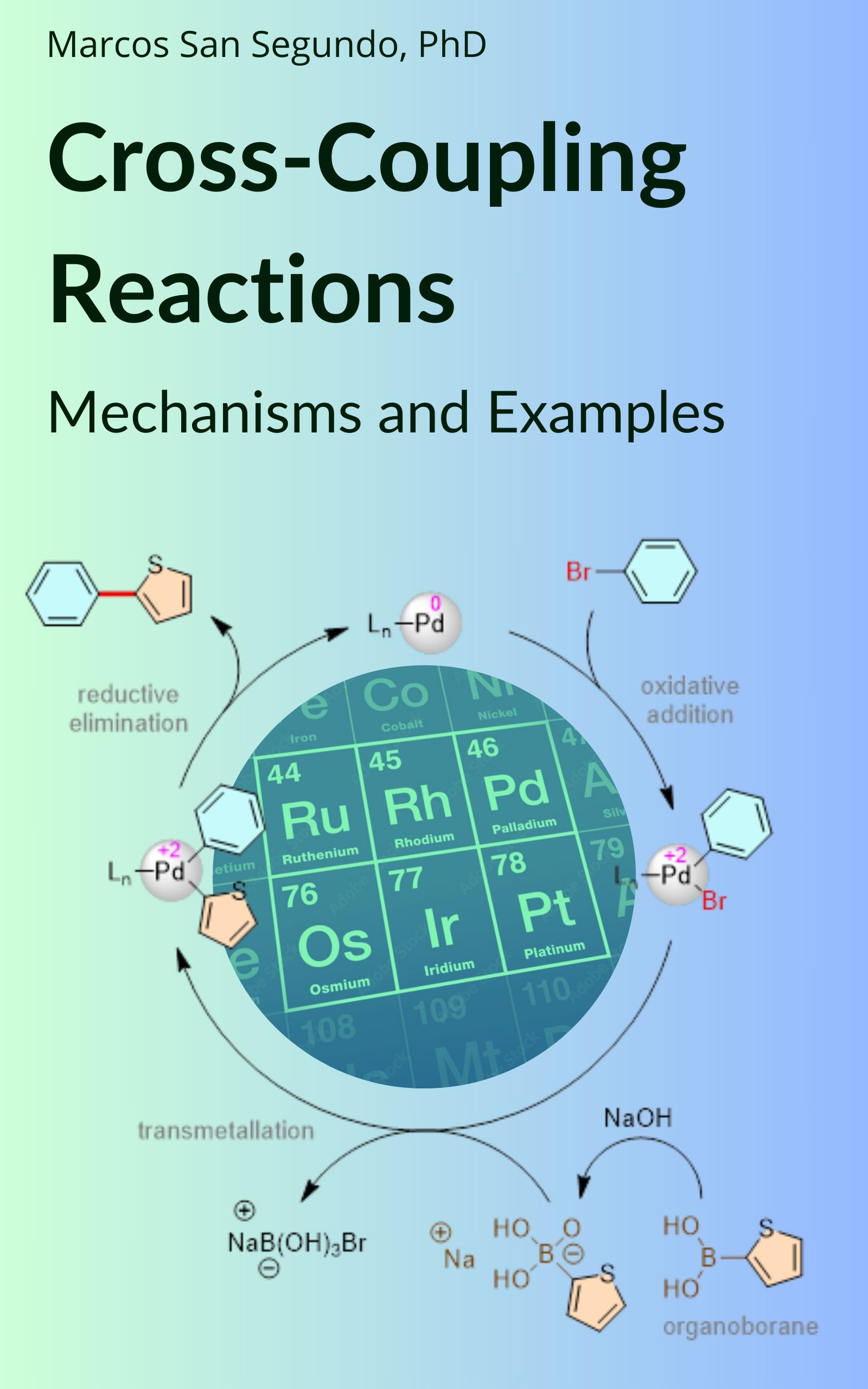
Cross-Coupling Reactions: Mechanisms and Examples
This page covers the Fukuyama Cross-Coupling — one of 21 named reactions in the book, each with its full catalytic cycle and every worked example shown here, drawn straight from the primary literature.