Negishi Cross-Coupling
Pd/Ni-catalyzed coupling of organozinc reagents
What is the Negishi Cross-Coupling?
The Negishi coupling joins an organozinc reagent with an aryl, vinyl, benzyl, or allyl halide under palladium or nickel catalysis. Organozincs sit in a useful reactivity middle ground: nucleophilic enough for fast transmetalation, yet far more functional-group tolerant than the Grignard reagents used in Kumada coupling, since zinc is less basic and less prone to side reactions with esters, nitriles, and ketones.
The reaction is not limited to forming biaryl bonds — it is one of the more reliable methods for coupling sp3 (alkyl) centers as well, which makes it a workhorse for installing benzylic and allylic substituents. Ei-ichi Negishi shared the 2010 Nobel Prize in Chemistry for this work, together with Akira Suzuki and Richard Heck.
Reaction schemes


Catalytic cycle
Oxidative addition
Pd(0) (or Ni(0)) inserts into the C–X bond of the halide.
Transmetalation
The organozinc reagent transfers its organic group to the metal center, with zinc halide as the byproduct.
Reductive elimination
The new C–C bond forms and the active catalyst is regenerated.
Applications
- Broad-scope C(sp2)–C(sp2) and C(sp2)–C(sp3) bond formation with high functional-group tolerance.
- A common choice when Kumada conditions are too harsh but Suzuki boronic acids are unavailable.
- Widely used in natural product and pharmaceutical total synthesis.
Worked examples
Every example below — reagents, conditions, and literature source — is reproduced from Cross-Coupling Reactions: Mechanisms and Examples by Marcos San Segundo, PhD.


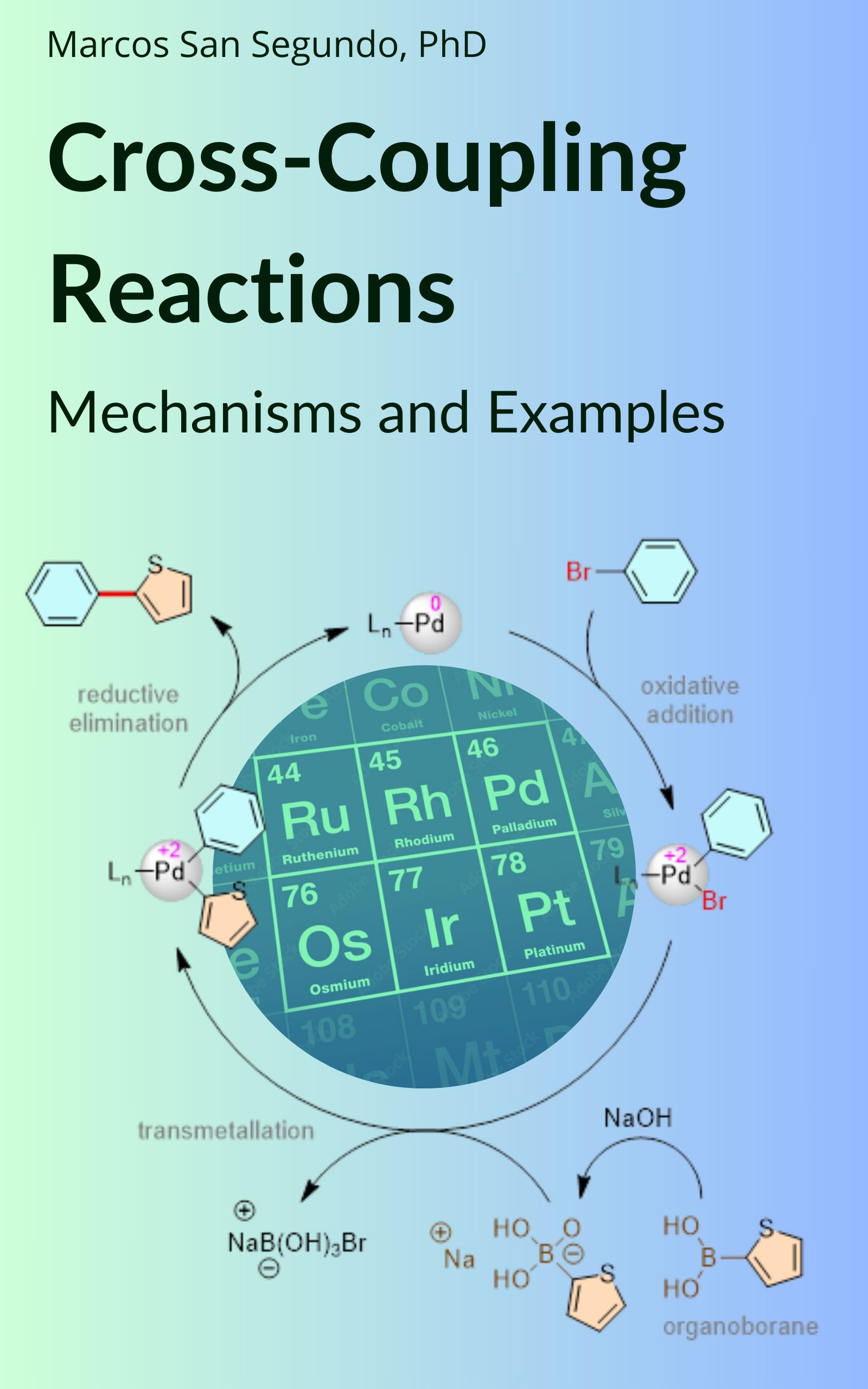
Cross-Coupling Reactions: Mechanisms and Examples
This page covers the Negishi Cross-Coupling — one of 21 named reactions in the book, each with its full catalytic cycle and every worked example shown here, drawn straight from the primary literature.