Eglinton Reaction
Cu(II)-mediated oxidative homocoupling of terminal alkynes
What is the Eglinton Reaction?
The Eglinton reaction oxidatively dimerizes two terminal alkynes into a symmetric 1,3-diyne using a stoichiometric copper(II) salt, most often copper(II) acetate in pyridine. Because pyridine solubilizes the copper acetate and coordinates the intermediate acetylide, the reaction can run under comparatively mild, homogeneous conditions.
Run intramolecularly, the same coupling closes macrocyclic rings containing a 1,3-diyne unit — a transformation made famous by early total syntheses of natural cyclic polyynes, where Eglinton conditions were often the most reliable way to forge the ring-closing diyne.
Reaction schemes


Catalytic cycle
Acetylide formation
The terminal alkyne is deprotonated and bound to copper(II) as an acetylide.
Oxidative dimerization
Two copper acetylide units combine; the copper(II)/copper(I) redox couple drives C–C bond formation between the two alkynyl fragments.
Diyne release
The 1,3-diyne product is released and the copper is reoxidized to close the cycle.
Applications
- Macrocyclization to cyclic polyynes in natural product total synthesis.
- Symmetric diyne synthesis for conjugated materials.
- A classical, reliable alternative to Glaser-Hay conditions when stoichiometric copper is not a concern.
Worked examples
Every example below — reagents, conditions, and literature source — is reproduced from Cross-Coupling Reactions: Mechanisms and Examples by Marcos San Segundo, PhD.


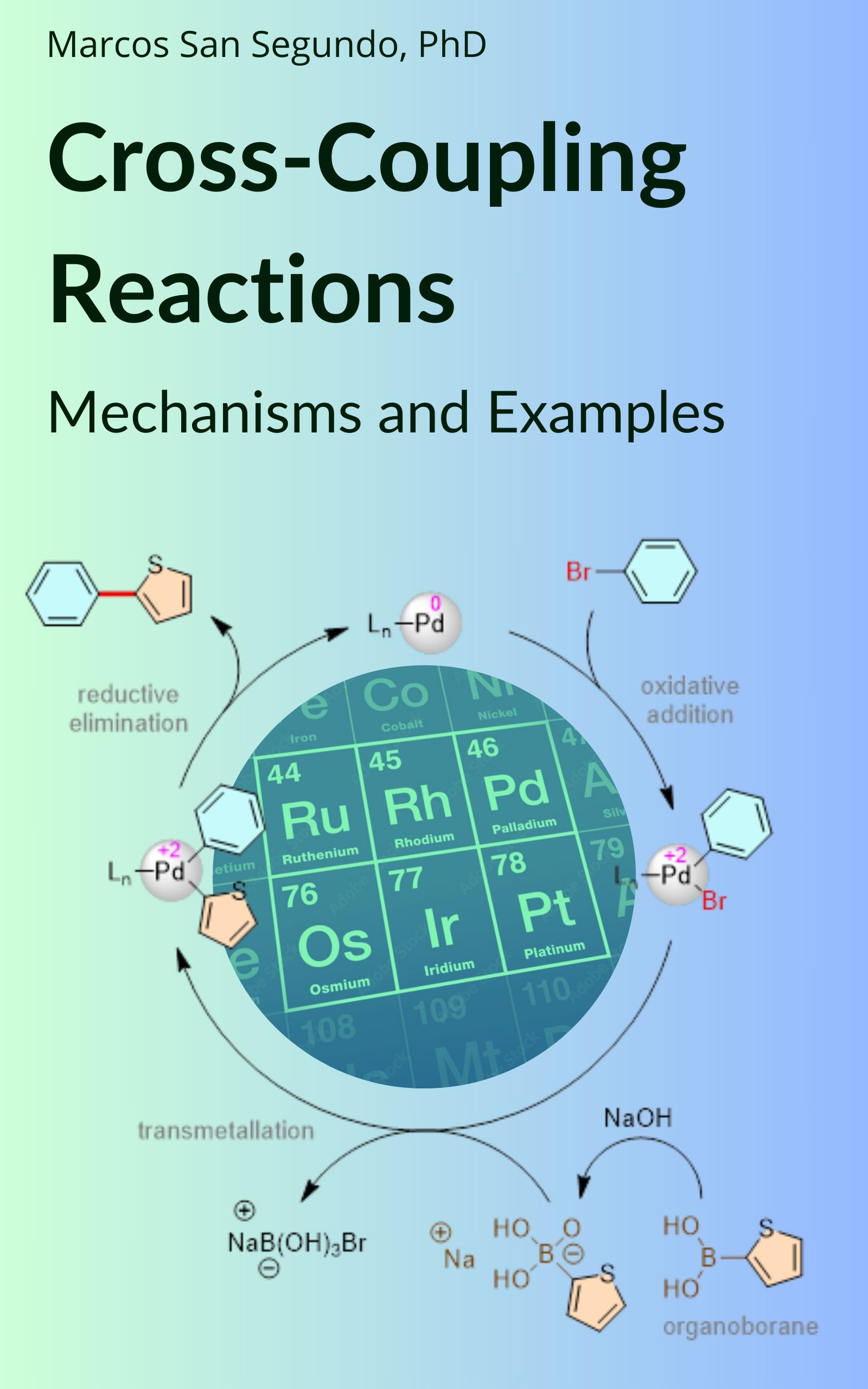
Cross-Coupling Reactions: Mechanisms and Examples
This page covers the Eglinton Reaction — one of 21 named reactions in the book, each with its full catalytic cycle and every worked example shown here, drawn straight from the primary literature.