Home / Reactions / Cross-Coupling Reactions / Buchwald-Hartwig Coupling

What is the Buchwald-Hartwig Coupling?

The Buchwald-Hartwig coupling replaced classical Ullmann-type amination with a palladium-catalyzed alternative that runs under far milder conditions and tolerates a much wider range of functional groups. It forms the C–N bond between an aryl (or vinyl) halide/pseudohalide and a primary or secondary amine, and the same catalytic manifold extends to phenols and amides, giving diaryl ethers and anilides as well.

The reaction's success hinges on the supporting ligand. Bulky, electron-rich monophosphines and biaryl phosphines (developed largely by the Buchwald group) accelerate the otherwise slow reductive elimination step and suppress unproductive β-hydride elimination pathways, which is what makes the modern versions practical for hindered and electron-poor substrates that defeated earlier catalyst generations.

Reaction schemes

Buchwald-Hartwig Coupling — general reaction scheme
Buchwald-Hartwig Coupling — catalytic cycle mechanism

Catalytic cycle

Step 1

Oxidative addition

Ln Pd(0) inserts into the Ar–X bond of the aryl halide, giving an Ln Pd(II)(Ar)(X) complex.

Step 2

Ligand exchange

The amine coordinates to Pd(II) and is deprotonated by base, placing the amido nitrogen directly on palladium.

Step 3

Reductive elimination

The Ar–N bond forms and Pd(0) is released to re-enter the cycle.

Applications

Worked examples

Every example below — reagents, conditions, and literature source — is reproduced from Cross-Coupling Reactions: Mechanisms and Examples by Marcos San Segundo, PhD.

Example 1

Coupling between 2-Pyridine bromide and a secondary aliphatic amine.

Scheme for Coupling between 2-Pyridine bromide and a secondary aliphatic amine. — Buchwald-Hartwig Coupling
Ref. [1]
Example 2

Coupling between an aryl chloride and an aniline catalyzed by Pd(OAc)2.

Scheme for Coupling between an aryl chloride and an aniline catalyzed by Pd(OAc)2. — Buchwald-Hartwig Coupling
Ref. [2]
Example 3

Coupling between an aryl bromide and ammonia.

Scheme for Coupling between an aryl bromide and ammonia. — Buchwald-Hartwig Coupling
Ref. [3]
Example 4

Coupling between an aryl bromide and a phenol catalyzed by Pd(OAc)2.

Scheme for Coupling between an aryl bromide and a phenol catalyzed by Pd(OAc)2. — Buchwald-Hartwig Coupling
Ref. [4]
Example 5

Multikilogram scale coupling by Eli Lilly.

Scheme for Multikilogram scale coupling by Eli Lilly. — Buchwald-Hartwig Coupling
Ref. [5]
Example 6

2.5 kg scale coupling by Pfizer.

Scheme for 2.5 kg scale coupling by Pfizer. — Buchwald-Hartwig Coupling
Ref. [6]
Example 7

Hydrazonation of an aryl chloride at 3.4 kg scale.

Scheme for Hydrazonation of an aryl chloride at 3.4 kg scale. — Buchwald-Hartwig Coupling
Ref. [7]
Example 8

Buchwald-Hartwig coupling under photocatalytic conditions.

Scheme for Buchwald-Hartwig coupling under photocatalytic conditions. — Buchwald-Hartwig Coupling
Ref. [8]
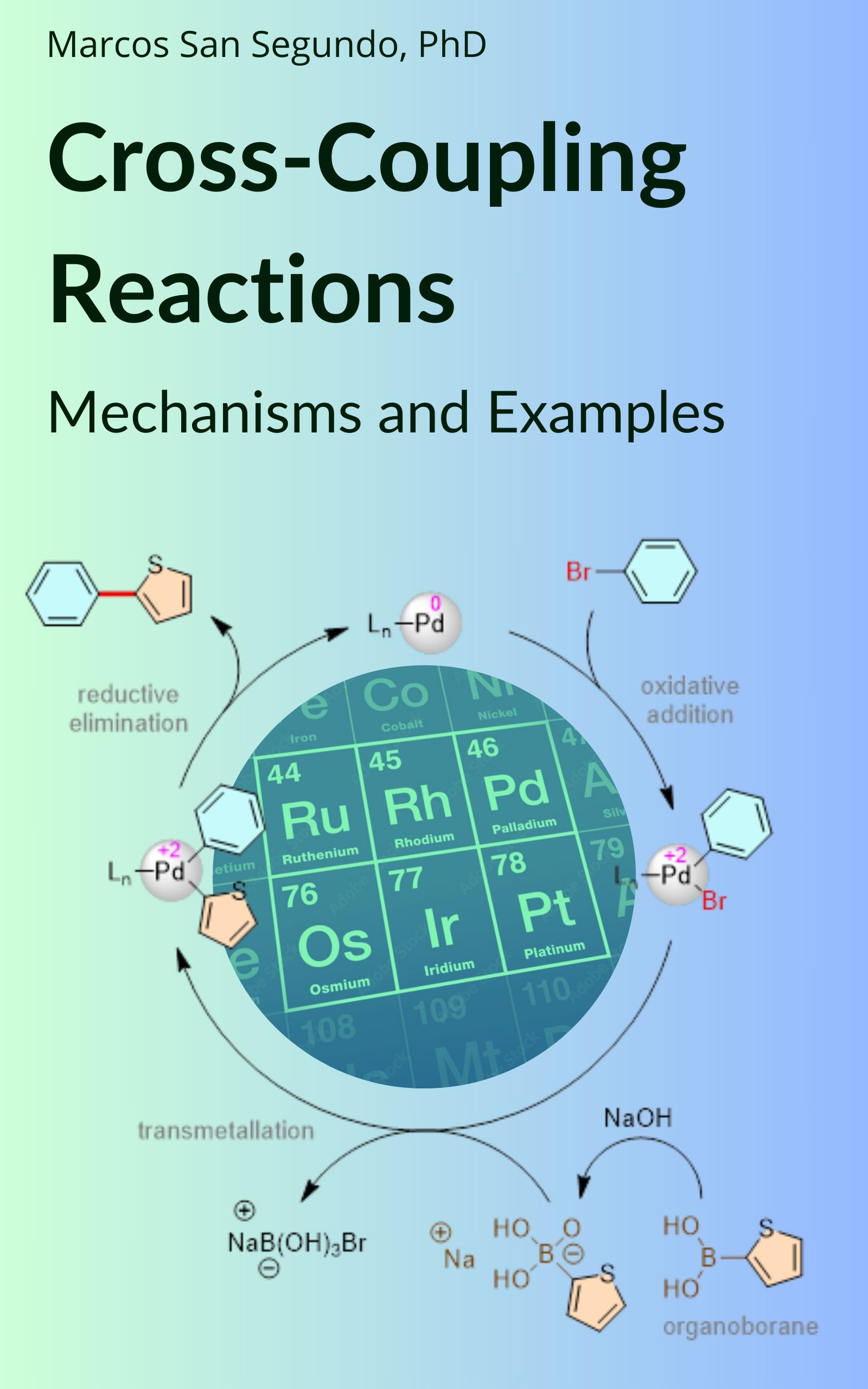
Cross-Coupling Reactions: Mechanisms and Examples book cover
Textbook · Organic Chemistry

Cross-Coupling Reactions: Mechanisms and Examples

This page covers the Buchwald-Hartwig Coupling — one of 21 named reactions in the book, each with its full catalytic cycle and every worked example shown here, drawn straight from the primary literature.

Get the book on Amazon → Free sample chapter

References

[1]
Sheng, Q.; Hartwig, J. F. Org. Lett. 2008, 10, 4109.
[2]
Fors, B. P.; Krattiger, P.; Strieter, E.; Buchwald, S. L. Org. Lett. 2008, 10, 3505.
[3]
Vo, G. D.; Hartwig, J. F. J. Am. Chem. Soc. 2009, 131, 11049.
[4]
Burgos, C. H.; Barder, T. E.; Huang, X.; Buchwald, S. L. Angew. Chem. Int. Ed. 2006, 45, 4321.
[5]
Mitchell, D.; Cole, K. P.; Pollock, P. M.; Coppert, D. M.; Burkholder, T. P.; Clayton, J. R. Org. Process Res. Dev. 2012, 16, 70.
[6]
Sperry, J. B.; Price Wiglesworth, K. E.; Edmonds, I.; Fiore, P.;Boyles, D. C.; Damon, D. B.; Dorow, R. L.; Piatnitski Chekler, E. L.;Langille, J.; Coe, J. W. Org. Process Res. Dev. 2014, 18, 1752.
[7]
Mauger, C. C.; Mignani, G. A. Org. Process Res. Dev. 2004, 8, 1065.
[8]
Corcoran, E. B.; Pirnot, M. T.; Lin, S.; Dreher, S. D.; DiRocco, D. A.; Davies, I. W.; Buchwald, S. L.; MacMillan, D. W. C. Science 2016, 353, 279.

Related reactions