Hiyama Cross-Coupling
Pd-catalyzed, fluoride-activated coupling of organosilanes
What is the Hiyama Cross-Coupling?
The Hiyama coupling joins an organosilicon reagent with an aryl or vinyl halide under palladium catalysis. Silicon is a poor leaving group and organosilanes are not intrinsically nucleophilic enough for transmetalation on their own, so the reaction requires an activator — usually a fluoride source such as TBAF, or a hydroxide/alkoxide base — that binds silicon and generates a hypervalent, pentacoordinate silicate. That silicate is nucleophilic enough to transfer its organic group to palladium.
Because organosilanes are low in toxicity, thermally stable, and easy to handle compared with the tin reagents used in the Stille coupling, the Hiyama coupling is often chosen as a greener alternative for aryl–aryl and aryl–vinyl bond formation.
Reaction schemes


Catalytic cycle
Oxidative addition
Pd(0) inserts into the Ar–X bond of the aryl or vinyl halide.
Silicate activation & transmetalation
Fluoride or hydroxide activates the organosilane into a nucleophilic silicate, which transfers its organic group to Pd(II).
Reductive elimination
The new C–C bond forms and Pd(0) is regenerated.
Applications
- A lower-toxicity alternative to Stille coupling for aryl–aryl and aryl–vinyl bond formation.
- Compatible with fluorinated and alkoxysilane building blocks used in medicinal chemistry.
- Widely used where tin residues in Stille chemistry would be unacceptable (e.g., regulated APIs).
Worked examples
Every example below — reagents, conditions, and literature source — is reproduced from Cross-Coupling Reactions: Mechanisms and Examples by Marcos San Segundo, PhD.


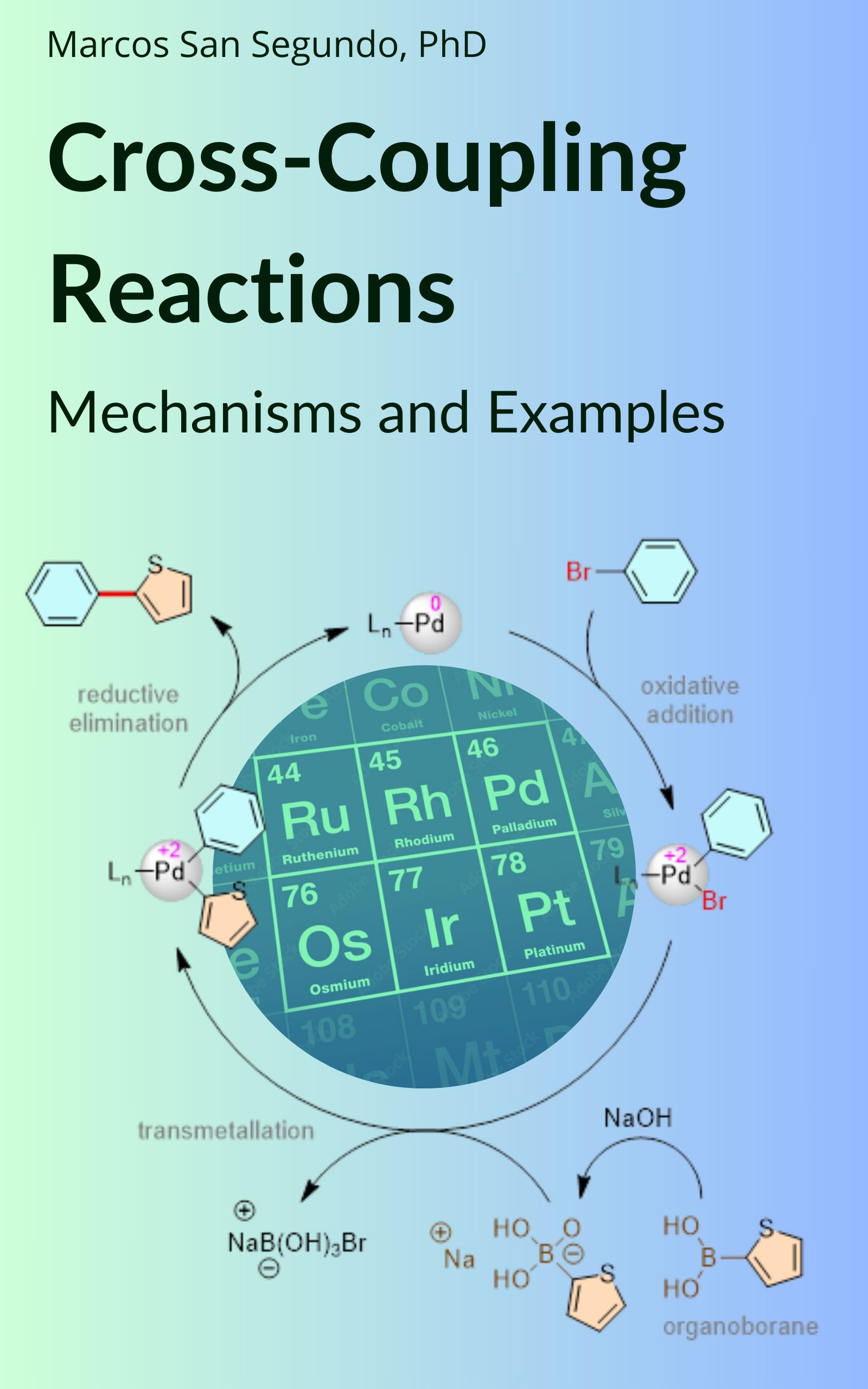
Cross-Coupling Reactions: Mechanisms and Examples
This page covers the Hiyama Cross-Coupling — one of 21 named reactions in the book, each with its full catalytic cycle and every worked example shown here, drawn straight from the primary literature.