Liebeskind-Srogl Cross-Coupling
Cu(I)-assisted, base-free coupling of thioesters/thioethers with boronic acids
What is the Liebeskind-Srogl Cross-Coupling?
The Liebeskind-Srogl coupling joins a thioester (or an aryl/heteroaryl thioether) with a boronic acid under palladium catalysis, using copper(I) thiophene-2-carboxylate (CuTC) as a stoichiometric thiophile that abstracts the sulfur and drives transmetalation forward. Because boronic acids are mild, and no strong base is required, the reaction is exceptionally functional-group tolerant.
That mildness makes it especially valuable for late-stage coupling on complex, densely functionalized substrates — including peptides and heterocycle-rich drug candidates — where the strongly basic or strongly nucleophilic conditions of Kumada, Negishi, or even standard Suzuki couplings would cause side reactions.
Reaction schemes


Catalytic cycle
Oxidative addition
Pd(0) inserts into the C–S bond of the thioester or thioether.
Sulfur abstraction & transmetalation
CuTC abstracts the thiolate as an insoluble copper thiolate, and the boronic acid transfers its organic group to palladium.
Reductive elimination
The new C–C bond forms, releasing the ketone or biaryl product and regenerating Pd(0).
Applications
- Late-stage, base-free ketone and biaryl synthesis on complex or sensitive substrates.
- Peptide and heterocycle functionalization where strong bases aren't tolerated.
- A complementary alternative to Fukuyama coupling for thioester activation.
Worked examples
Every example below — reagents, conditions, and literature source — is reproduced from Cross-Coupling Reactions: Mechanisms and Examples by Marcos San Segundo, PhD.


Liebeskind-Srogl coupling in peptides with vinyl boronic acid. The chiral centres do not racemized.


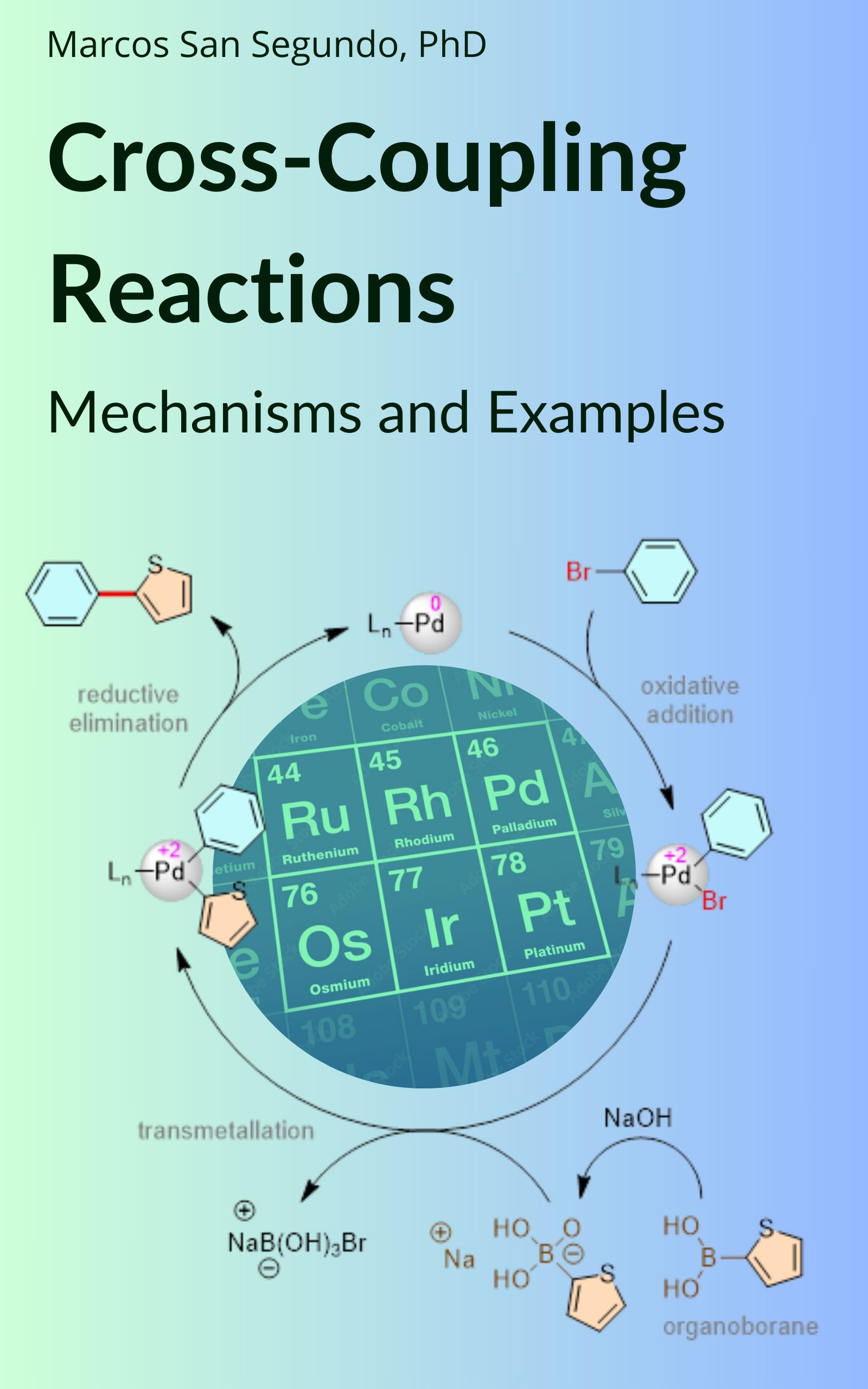
Cross-Coupling Reactions: Mechanisms and Examples
This page covers the Liebeskind-Srogl Cross-Coupling — one of 21 named reactions in the book, each with its full catalytic cycle and every worked example shown here, drawn straight from the primary literature.