Heck Cross-Coupling
Pd-catalyzed coupling of aryl/vinyl halides with alkenes
What is the Heck Cross-Coupling?
The Heck reaction couples an aryl or vinyl halide with an alkene to give a new, substituted alkene — without needing a preformed organometallic coupling partner on the alkene side, which sets it apart mechanistically from Suzuki, Negishi, Stille, Kumada, and Hiyama coupling. The alkene itself is the nucleophile, inserting directly into the Pd–aryl bond.
The reaction typically delivers the (E)-alkene with high selectivity, since migratory insertion and the subsequent syn β-hydride elimination proceed through well-defined stereochemical pathways. Richard Heck shared the 2010 Nobel Prize in Chemistry with Ei-ichi Negishi and Akira Suzuki for this and related palladium-catalyzed coupling chemistry.
Reaction schemes


Catalytic cycle
Oxidative addition
Pd(0) inserts into the Ar–X bond of the aryl or vinyl halide.
Migratory insertion
The alkene coordinates to palladium and inserts into the Pd–Ar bond (syn addition).
β-Hydride elimination
A β-hydrogen is eliminated to release the new alkene product and an H–Pd–X species; base regenerates Pd(0) for the next cycle.
Applications
- Industrial-scale synthesis of stilbene- and cinnamate-type pharmaceutical intermediates.
- Intramolecular Heck reactions for ring construction in complex molecule synthesis.
- Styrene and conjugated-alkene building blocks for materials chemistry.
Worked examples
Every example below — reagents, conditions, and literature source — is reproduced from Cross-Coupling Reactions: Mechanisms and Examples by Marcos San Segundo, PhD.


Intramolecular Heck reaction.


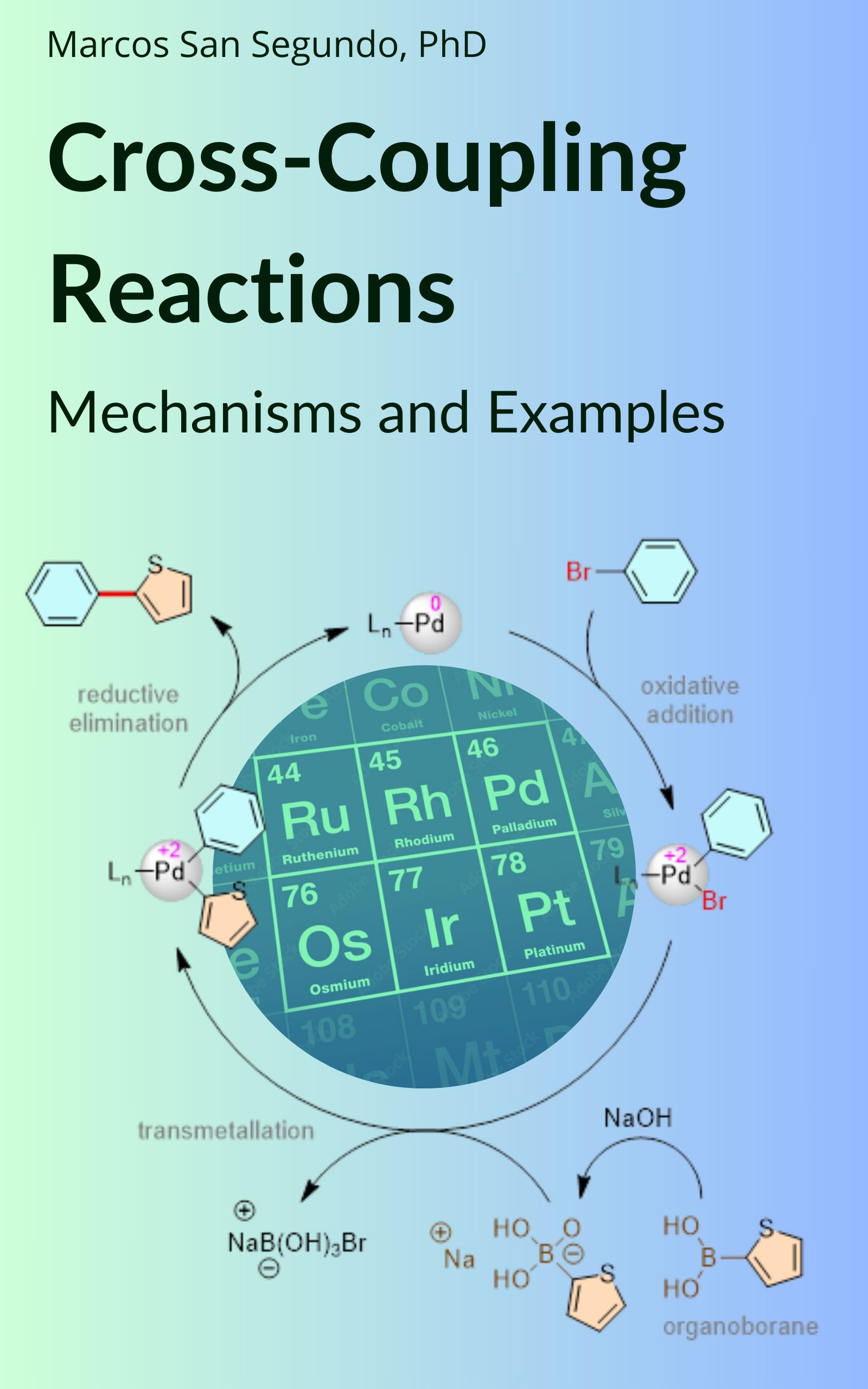
Cross-Coupling Reactions: Mechanisms and Examples
This page covers the Heck Cross-Coupling — one of 21 named reactions in the book, each with its full catalytic cycle and every worked example shown here, drawn straight from the primary literature.