Hiyama-Denmark Cross-Coupling
Fluoride-free silanol coupling
What is the Hiyama-Denmark Cross-Coupling?
The Hiyama-Denmark coupling is a fluoride-free variant of the Hiyama coupling, developed by Scott Denmark, that uses silanols (Si–OH) as the organosilicon partner. Because the free silanol is activated directly by a mild base (such as KOH or KOTMS) rather than by fluoride, silicon-based protecting groups that would otherwise be stripped by TBAF — TBS, TIPS, and related silyl ethers — survive the reaction conditions untouched.
That chemoselectivity is the main reason to reach for Hiyama-Denmark conditions over the classical fluoride-activated Hiyama coupling: it lets chemists carry silyl-protected alcohols through a cross-coupling step without a separate deprotection/reprotection sequence.
Reaction scheme

Catalytic cycle
Oxidative addition
Pd(0) inserts into the Ar–X bond of the aryl or vinyl halide.
Base activation & transmetalation
A mild base deprotonates the silanol; the resulting silanolate transfers its organic group to Pd(II) without needing fluoride.
Reductive elimination
The C–C bond forms and Pd(0) is regenerated.
Applications
- Cross-coupling steps late in a synthesis that also carries TBS/TIPS-protected alcohols.
- Fluoride-sensitive substrates where classical Hiyama conditions are not an option.
- An operationally mild alternative for aryl–vinyl and aryl–aryl bond formation.
Worked examples
Every example below — reagents, conditions, and literature source — is reproduced from Cross-Coupling Reactions: Mechanisms and Examples by Marcos San Segundo, PhD.


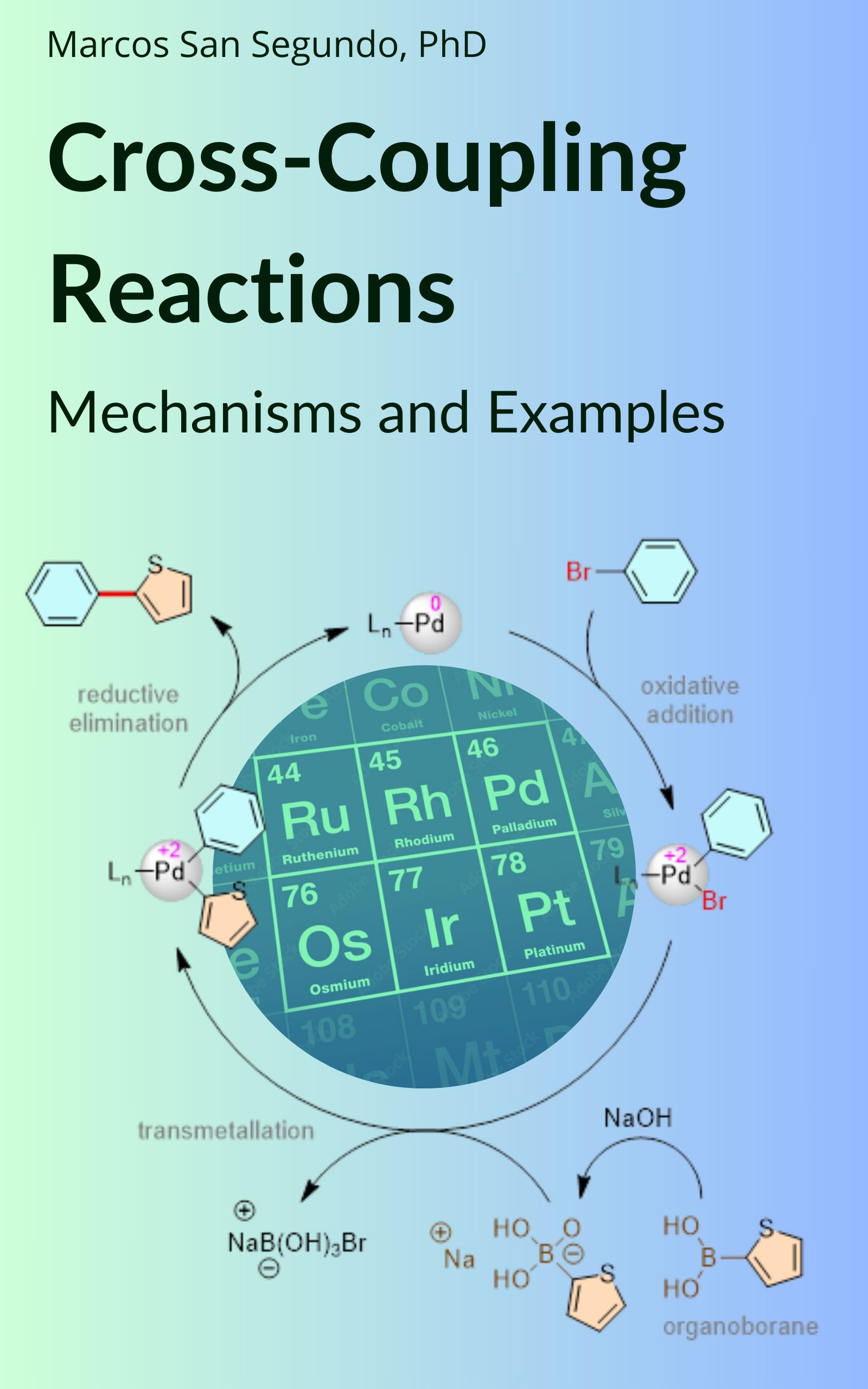
Cross-Coupling Reactions: Mechanisms and Examples
This page covers the Hiyama-Denmark Cross-Coupling — one of 21 named reactions in the book, each with its full catalytic cycle and every worked example shown here, drawn straight from the primary literature.