Ullmann Aryl-Aryl Coupling
Cu-mediated symmetric biaryl synthesis
What is the Ullmann Aryl-Aryl Coupling?
The classical Ullmann aryl-aryl coupling homocouples two molecules of an aryl halide into a symmetric biaryl using copper, historically in stoichiometric amounts at high temperature (often well above 200 °C). It was, for decades, essentially the only general method for making biaryl bonds, long before palladium catalysis existed.
Modern ligand-accelerated versions run with catalytic copper at far milder temperatures, and mechanistic studies suggest the reaction can proceed either through discrete Cu(I)/Cu(III) oxidative addition-reductive elimination steps (analogous to the palladium cycle) or through single-electron-transfer, radical-type pathways, depending on the substrate and ligand system — the field has not fully settled on one unified mechanism.
Reaction schemes


Catalytic cycle
Ar–Cu formation
Copper inserts into the Ar–X bond of one aryl halide molecule, by oxidative addition or a radical pathway.
Second C–X activation
A second equivalent of the aryl halide reacts at copper, either via oxidative addition to Cu(III) or radical recombination.
C–C bond formation
Reductive elimination (or radical coupling) delivers the symmetric biaryl and regenerates active copper.
Applications
- Symmetric biaryl synthesis where a palladium catalyst is undesirable or unavailable.
- A historically important precedent for all later transition-metal cross-coupling chemistry.
- Still used for robust, high-temperature biaryl formation on simple substrates.
Worked examples
Every example below — reagents, conditions, and literature source — is reproduced from Cross-Coupling Reactions: Mechanisms and Examples by Marcos San Segundo, PhD.


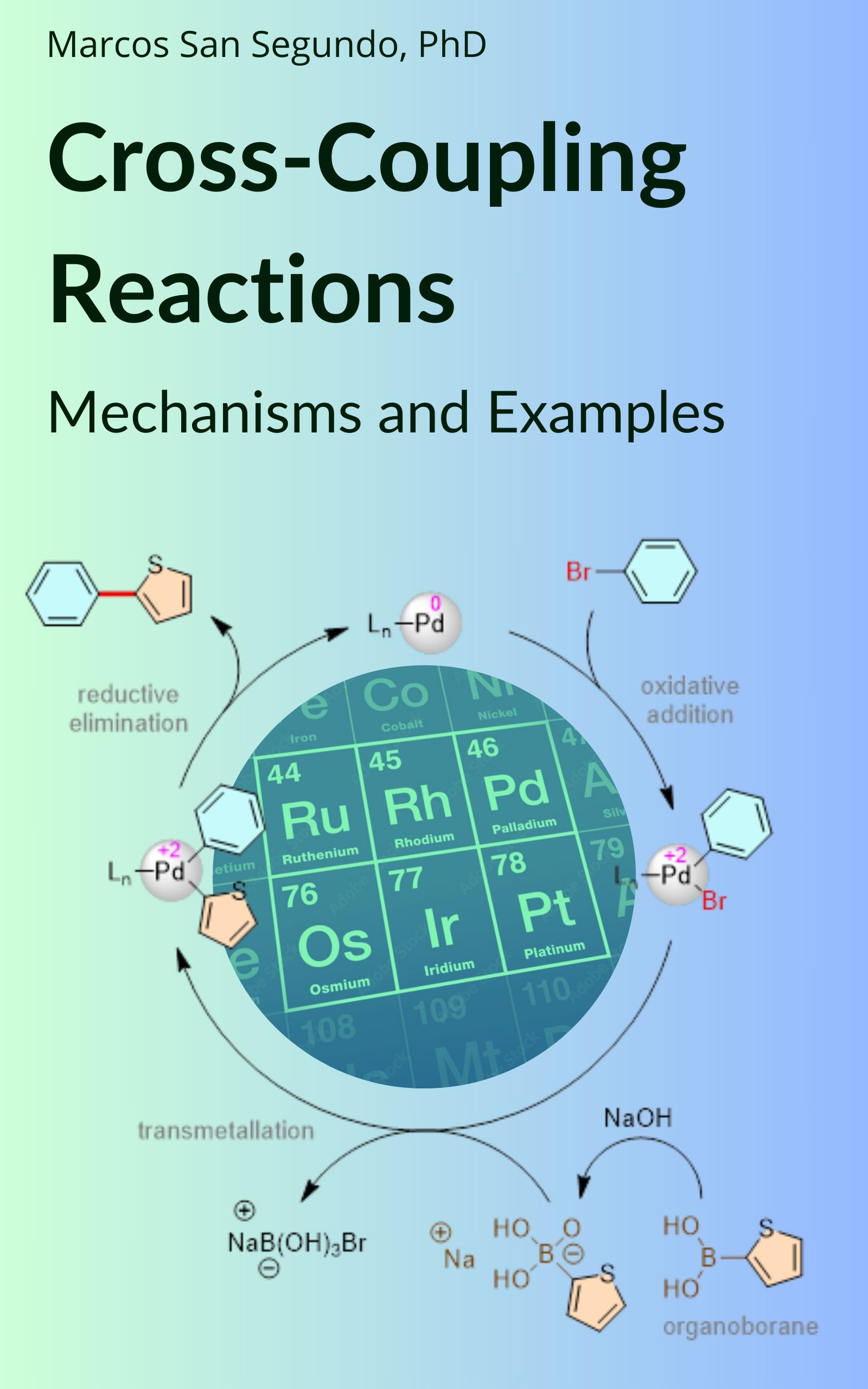
Cross-Coupling Reactions: Mechanisms and Examples
This page covers the Ullmann Aryl-Aryl Coupling — one of 21 named reactions in the book, each with its full catalytic cycle and every worked example shown here, drawn straight from the primary literature.