Stille Cross-Coupling
Pd-catalyzed, base-free coupling of organostannanes
What is the Stille Cross-Coupling?
The Stille coupling joins an organostannane (R–SnBu3) with an aryl or vinyl halide or triflate under palladium catalysis. Organotin reagents are directly nucleophilic enough to transmetalate onto palladium without needing an added base or activator, which makes the reaction unusually mild and tolerant of base-sensitive functionality — a real practical advantage over Suzuki or Negishi couplings in some settings.
The trade-off is toxicity: organotin compounds and their byproducts are more hazardous than the boron or zinc reagents used elsewhere, and residual tin can be difficult to remove during purification. Those concerns have pushed much of modern practice toward Suzuki or Hiyama coupling wherever they are viable substitutes, but the Stille coupling remains valuable for substrates and transformations where it is still the most reliable option.
Reaction schemes


Catalytic cycle
Oxidative addition
Pd(0) inserts into the Ar–X bond of the halide or triflate.
Transmetalation
The organostannane transfers its organic group directly to palladium(II), without needing an external base.
Reductive elimination
The new C–C bond forms and Pd(0) is regenerated.
Applications
- Base-free coupling on substrates with base-sensitive stereocenters or protecting groups.
- Vinyl stannane couplings in natural product total synthesis.
- Carbonylative variants for direct ketone synthesis (see Carbonylative Stille Coupling).
Worked examples
Every example below — reagents, conditions, and literature source — is reproduced from Cross-Coupling Reactions: Mechanisms and Examples by Marcos San Segundo, PhD.


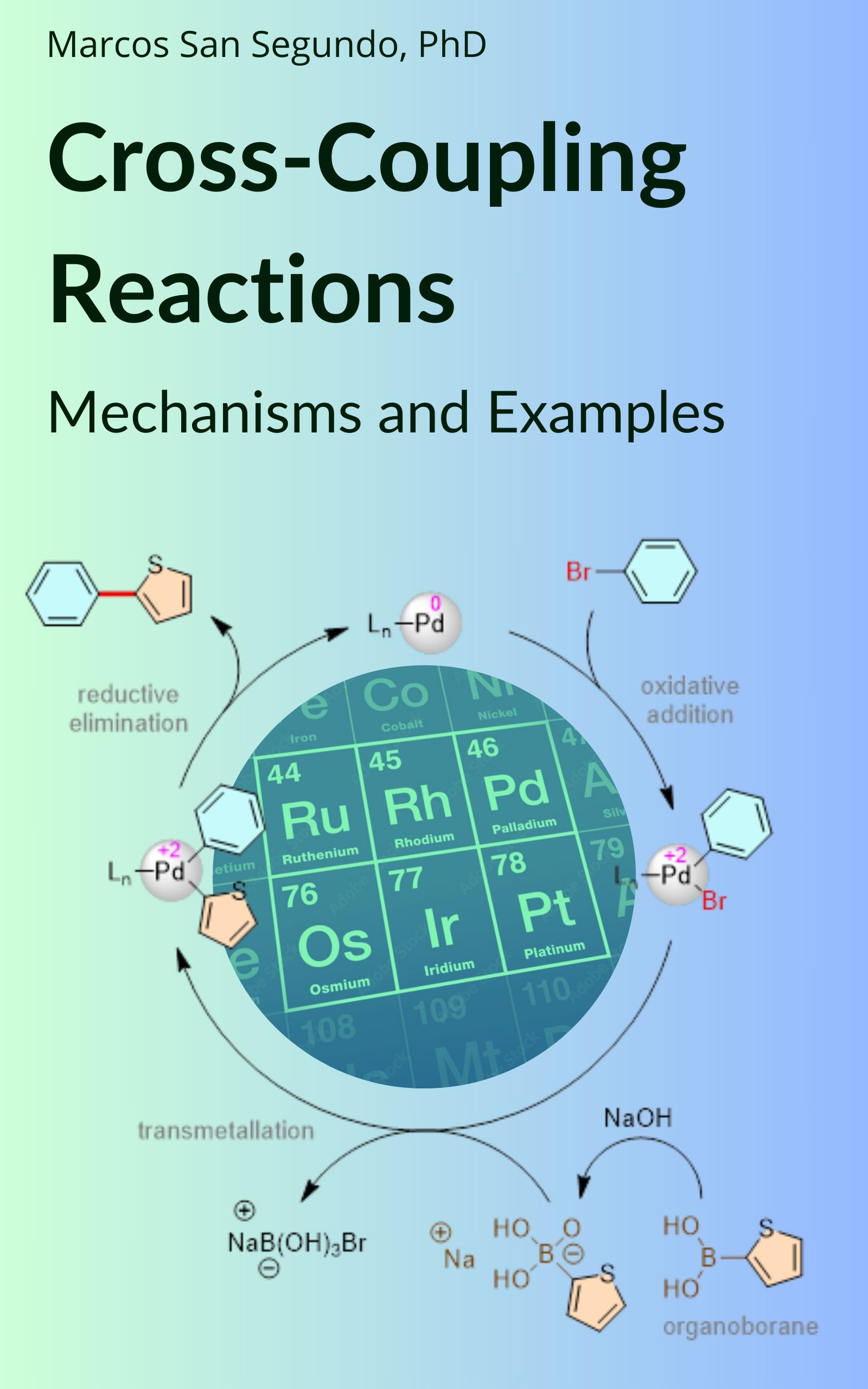
Cross-Coupling Reactions: Mechanisms and Examples
This page covers the Stille Cross-Coupling — one of 21 named reactions in the book, each with its full catalytic cycle and every worked example shown here, drawn straight from the primary literature.