Sonogashira Cross-Coupling
Pd/Cu dual-catalyzed coupling of terminal alkynes
What is the Sonogashira Cross-Coupling?
The Sonogashira coupling joins a terminal alkyne with an aryl, heteroaryl, or vinyl halide using a combined palladium/copper catalyst system and an amine base. The copper co-catalyst forms a copper acetylide from the terminal alkyne — activating its otherwise unreactive C–H bond — which then transmetalates onto the palladium center generated by oxidative addition into the aryl halide.
It is one of the most heavily used cross-couplings in synthetic and medicinal chemistry for building conjugated aryl-alkyne and enyne systems. Copper-free variants exist for substrates prone to Glaser-type alkyne homocoupling, but the classical Pd/Cu combination remains the default starting point.
Reaction schemes


Catalytic cycle
Oxidative addition
Pd(0) inserts into the Ar–X bond of the aryl or heteroaryl halide.
Copper acetylide formation & transmetalation
Cu(I) and amine base convert the terminal alkyne into a copper acetylide, which transfers the alkynyl group to Pd(II).
Reductive elimination
The new C(sp2)–C(sp) bond forms, releasing the alkynylated product and regenerating Pd(0).
Applications
- Conjugated aryl-alkyne synthesis for pharmaceuticals and OLED/organic-electronic materials.
- Enyne and diyne natural product synthesis.
- Copper-free variants for alkyne-sensitive or Glaser-prone substrates.
Worked examples
Every example below — reagents, conditions, and literature source — is reproduced from Cross-Coupling Reactions: Mechanisms and Examples by Marcos San Segundo, PhD.


Coupling between an aryl fluoride and an aryl alkyne.

Coupling between a vinyl bromide and an aryl alkyne.


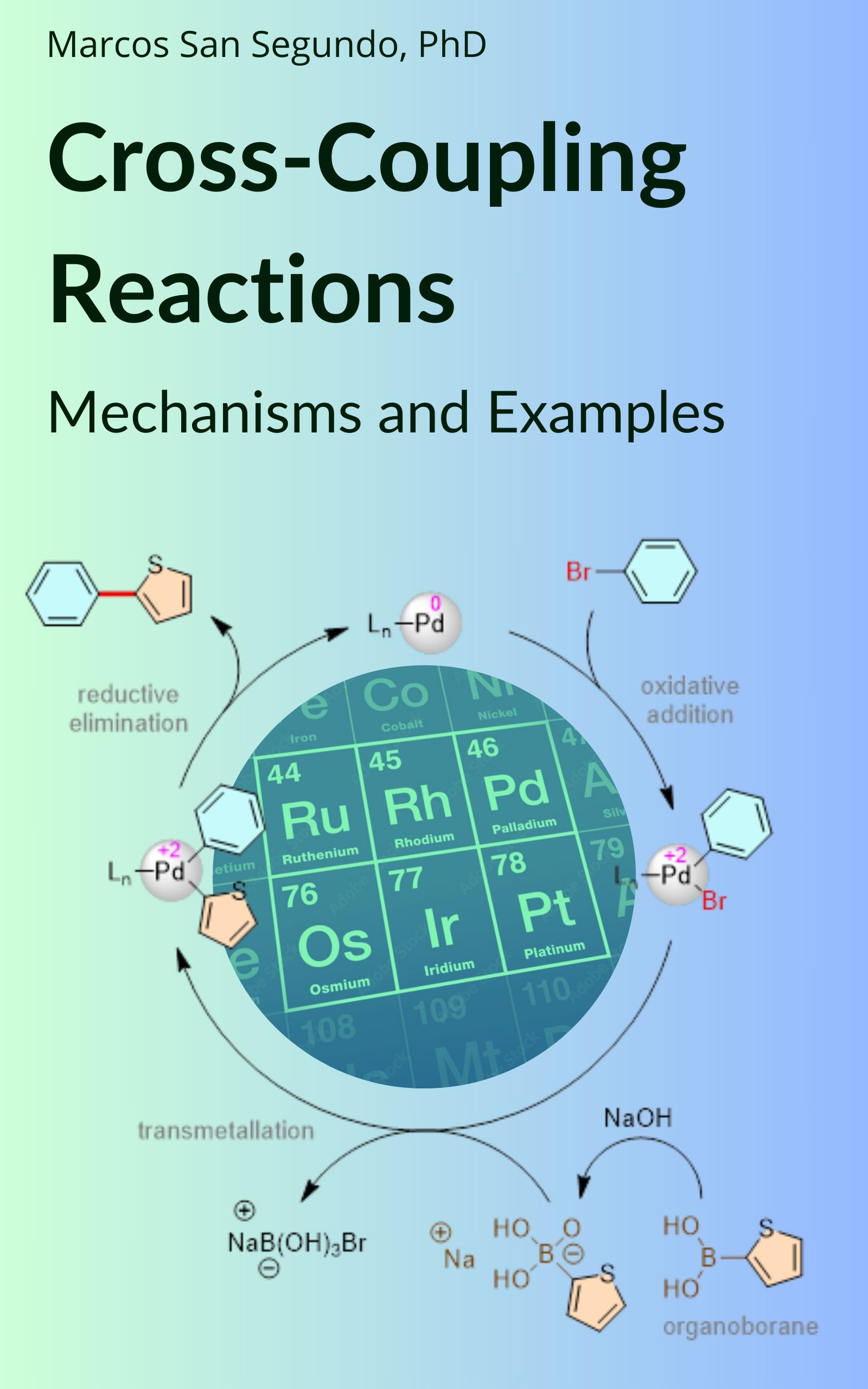
Cross-Coupling Reactions: Mechanisms and Examples
This page covers the Sonogashira Cross-Coupling — one of 21 named reactions in the book, each with its full catalytic cycle and every worked example shown here, drawn straight from the primary literature.