Miyaura Borylation
Pd-catalyzed synthesis of aryl/vinyl boronates from B2pin2
What is the Miyaura Borylation?
The Miyaura borylation installs a pinacol boronate ester onto an aryl or vinyl halide (or triflate) by coupling it with bis(pinacolato)diboron (B2pin2) under palladium catalysis, using a mild base such as potassium acetate. It is the standard way to make boronic esters that are not easily accessible from a boronic acid starting material.
The products feed directly into a downstream Suzuki coupling, so Miyaura borylation and Suzuki coupling are frequently run as a two-step, one-pot sequence — first installing the boronate on one fragment, then coupling it to a second aryl halide — a strategy widely used to build complex biaryl and heterobiaryl scaffolds from simple halide starting materials.
Reaction schemes


Catalytic cycle
Oxidative addition
Pd(0) inserts into the Ar–X bond of the aryl or vinyl halide/triflate.
Base-assisted ligand exchange
Acetate activates B2pin2 at boron, enabling transfer of a Bpin group to palladium(II).
Reductive elimination
The Ar–Bpin bond forms and Pd(0) is regenerated.
Applications
- Access to boronic esters not readily available from boronic acids directly.
- One-pot borylation/Suzuki sequences for biaryl synthesis.
- Vinyl boronate synthesis for subsequent stereospecific couplings.
Worked examples
Every example below — reagents, conditions, and literature source — is reproduced from Cross-Coupling Reactions: Mechanisms and Examples by Marcos San Segundo, PhD.


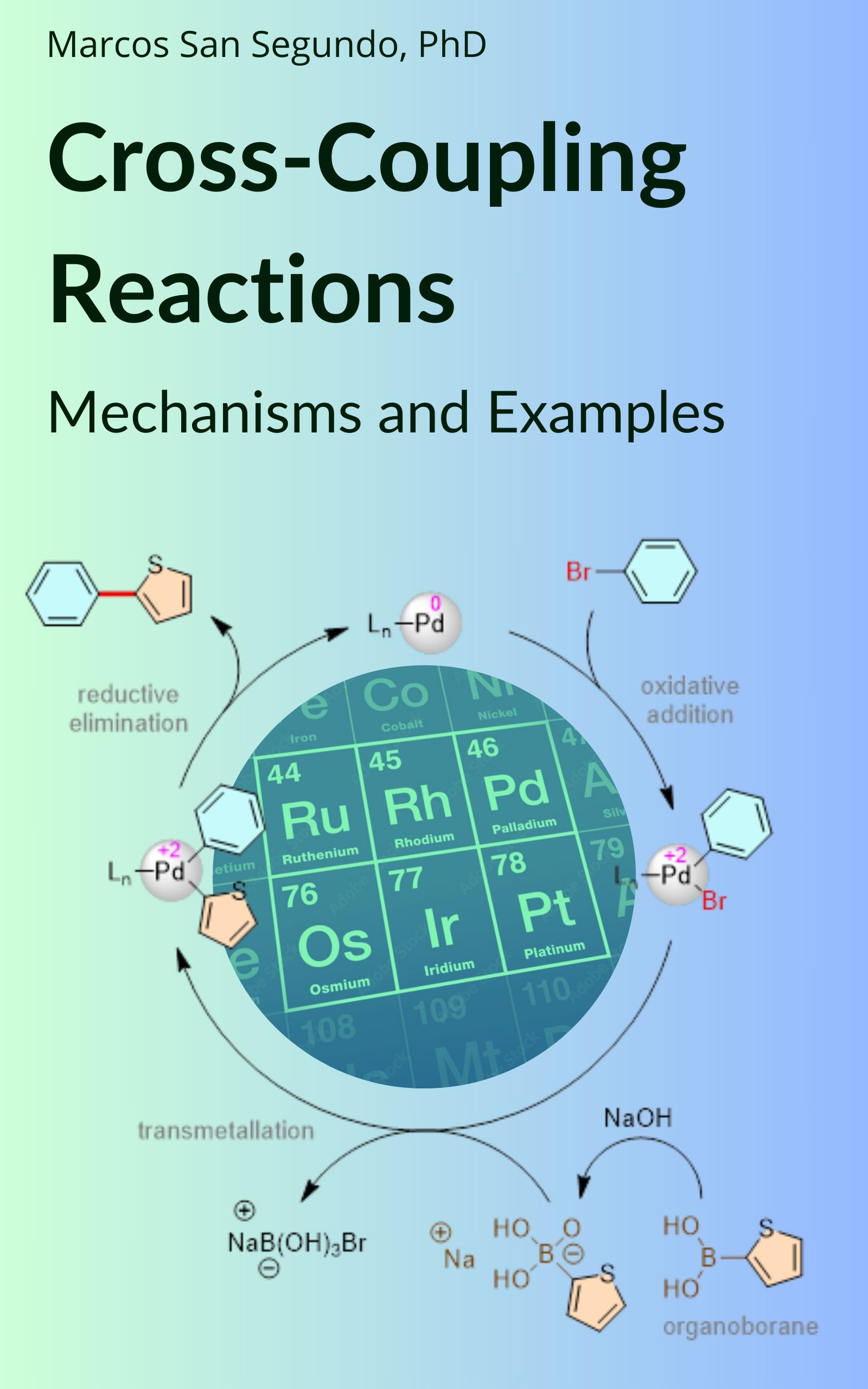
Cross-Coupling Reactions: Mechanisms and Examples
This page covers the Miyaura Borylation — one of 21 named reactions in the book, each with its full catalytic cycle and every worked example shown here, drawn straight from the primary literature.