Kumada Cross-Coupling
Ni/Pd-catalyzed coupling of Grignard reagents
What is the Kumada Cross-Coupling?
The Kumada coupling — the earliest of the transition-metal-catalyzed cross-couplings, reported in 1972 — joins a Grignard reagent directly with an aryl, vinyl, or heteroaryl halide under nickel or palladium catalysis. Because the Grignard is both highly reactive and directly organometallic, transmetalation is fast and the reaction can proceed at low catalyst loadings and mild temperatures.
That same reactivity is also its main limitation: Grignard reagents are strongly basic and nucleophilic, so esters, ketones, nitriles, and other electrophilic functional groups on the substrate generally have to be avoided or protected. Nickel catalysts are frequently preferred over palladium here because they activate the otherwise sluggish aryl chlorides efficiently.
Reaction schemes


Catalytic cycle
Oxidative addition
Ni(0) or Pd(0) inserts into the Ar–X bond of the aryl halide.
Transmetalation
The Grignard reagent transfers its organic group directly to the metal center.
Reductive elimination
The new C–C bond forms and the active catalyst is regenerated.
Applications
- Fast, low-catalyst-loading biaryl and heterobiaryl synthesis where sensitive functionality isn't a concern.
- Nickel-catalyzed variants for activating inexpensive aryl chlorides.
- Conjugated polymer synthesis via Grignard metathesis (GRIM) polymerization.
Worked examples
Every example below — reagents, conditions, and literature source — is reproduced from Cross-Coupling Reactions: Mechanisms and Examples by Marcos San Segundo, PhD.


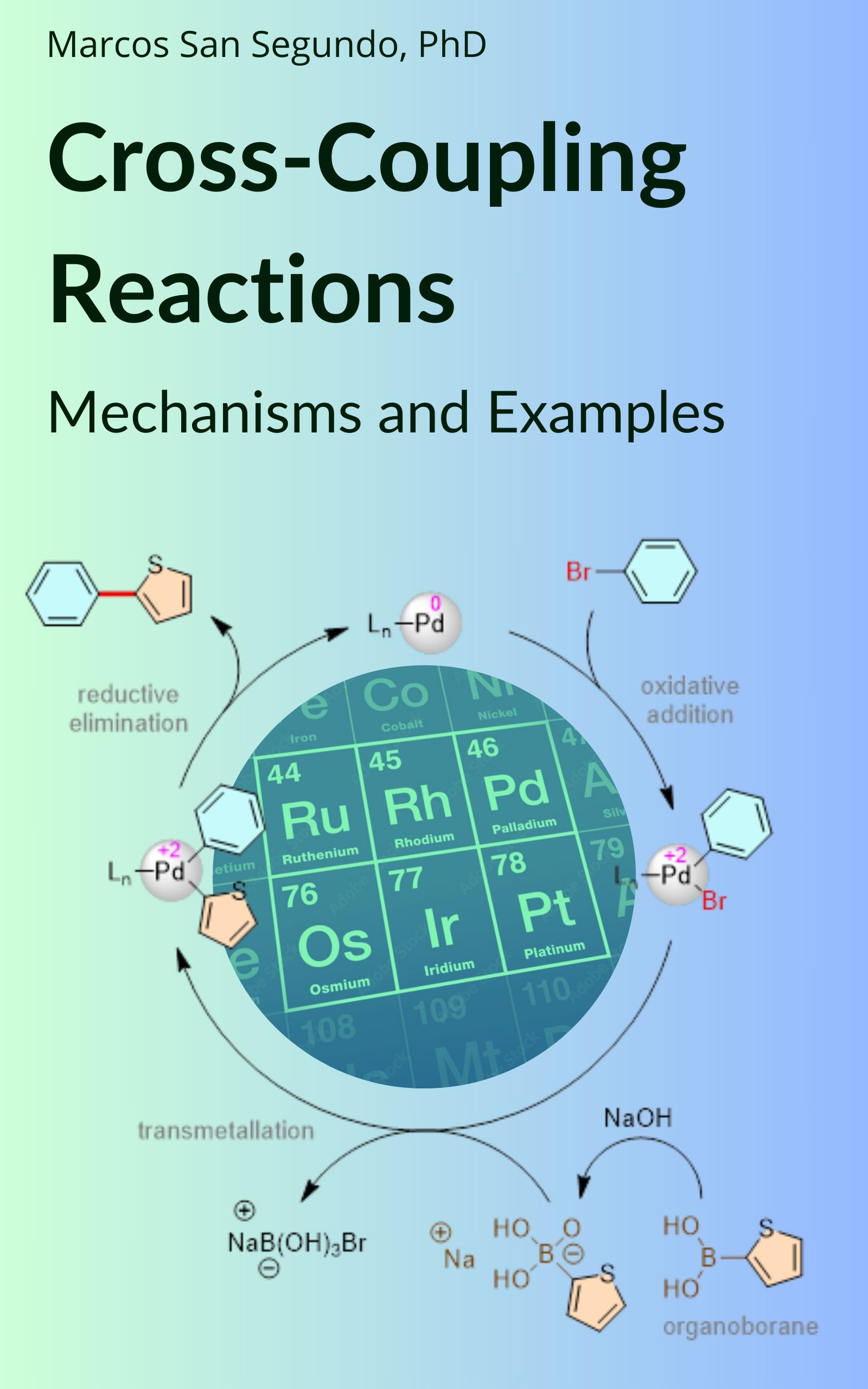
Cross-Coupling Reactions: Mechanisms and Examples
This page covers the Kumada Cross-Coupling — one of 21 named reactions in the book, each with its full catalytic cycle and every worked example shown here, drawn straight from the primary literature.