Glaser-Eglinton-Hay Coupling
Catalytic Cu(I)/O2 oxidative alkyne homocoupling
What is the Glaser-Eglinton-Hay Coupling?
The Glaser-Eglinton-Hay coupling is the catalytic, air-reoxidized descendant of Glaser's original 1869 alkyne-coupling chemistry. Instead of consuming a stoichiometric copper(II) oxidant, the Hay modification uses a catalytic Cu(I)/TMEDA complex with atmospheric oxygen as the terminal oxidant, making it milder, cheaper, and easier to run at scale than the original Glaser or Eglinton protocols.
Like the Eglinton reaction, it dimerizes terminal alkynes into 1,3-diynes and is equally at home in intramolecular macrocyclizations. The TMEDA ligand keeps copper soluble and well-behaved throughout the catalytic cycle, which is part of why Hay conditions became the default choice for diyne macrocyclization in modern total synthesis.
Reaction schemes


Catalytic cycle
Acetylide formation
The terminal alkyne binds to Cu(I)/TMEDA as a copper acetylide.
Oxidative dimerization
Two acetylide units couple through a Cu(I)/Cu(II) redox cycle.
Catalyst turnover
Atmospheric O2 reoxidizes the copper, regenerating the active catalyst for another cycle.
Applications
- The standard modern method for diyne and diyne-macrocycle synthesis in total synthesis.
- Conjugated polymer and molecular-wire synthesis.
- Lower copper loading than Eglinton or classical Glaser conditions, since O2 handles reoxidation.
Worked examples
Every example below — reagents, conditions, and literature source — is reproduced from Cross-Coupling Reactions: Mechanisms and Examples by Marcos San Segundo, PhD.


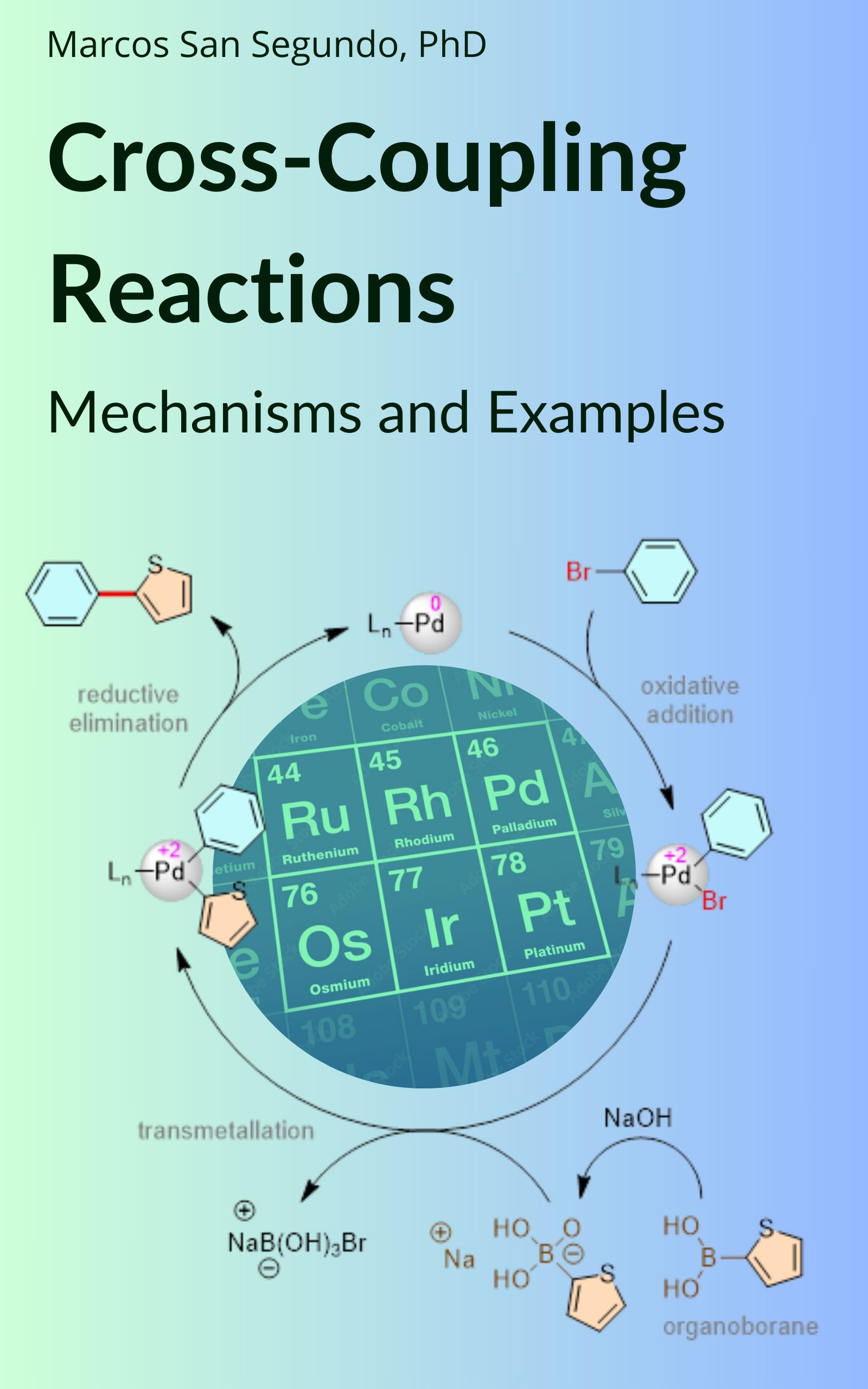
Cross-Coupling Reactions: Mechanisms and Examples
This page covers the Glaser-Eglinton-Hay Coupling — one of 21 named reactions in the book, each with its full catalytic cycle and every worked example shown here, drawn straight from the primary literature.