Carbonylative Stille Coupling
Stille coupling under CO to give ketones
What is the Carbonylative Stille Coupling?
The carbonylative Stille coupling runs the standard Stille coupling under an atmosphere of carbon monoxide, intercepting the aryl-palladium intermediate before transmetalation and inserting CO to form an acyl-palladium species instead. The stannane then couples onto that acyl center, delivering a ketone rather than the direct biaryl or aryl-vinyl product of the uncarbonylated reaction.
This turns a simple aryl or vinyl halide into a one-pot precursor for unsymmetrical ketones, without needing to preform an acid chloride or other activated acyl electrophile — a particularly useful shortcut in peptide and natural product synthesis, where an extra activation step could compromise sensitive stereocenters or protecting groups.
Reaction schemes


Catalytic cycle
Oxidative addition
Pd(0) inserts into the Ar–X bond of the halide.
CO insertion
Carbon monoxide inserts into the Pd–Ar bond (migratory insertion), giving an acyl-palladium(II) intermediate.
Transmetalation & reductive elimination
The organostannane transfers its group to the acyl-palladium center, and reductive elimination releases the ketone product.
Applications
- One-pot ketone synthesis from simple halides without a separate acylation step.
- Peptide-backbone ketone installation.
- Access to unsymmetrical diaryl and aryl-alkyl ketones under mild conditions.
Worked examples
Every example below — reagents, conditions, and literature source — is reproduced from Cross-Coupling Reactions: Mechanisms and Examples by Marcos San Segundo, PhD.


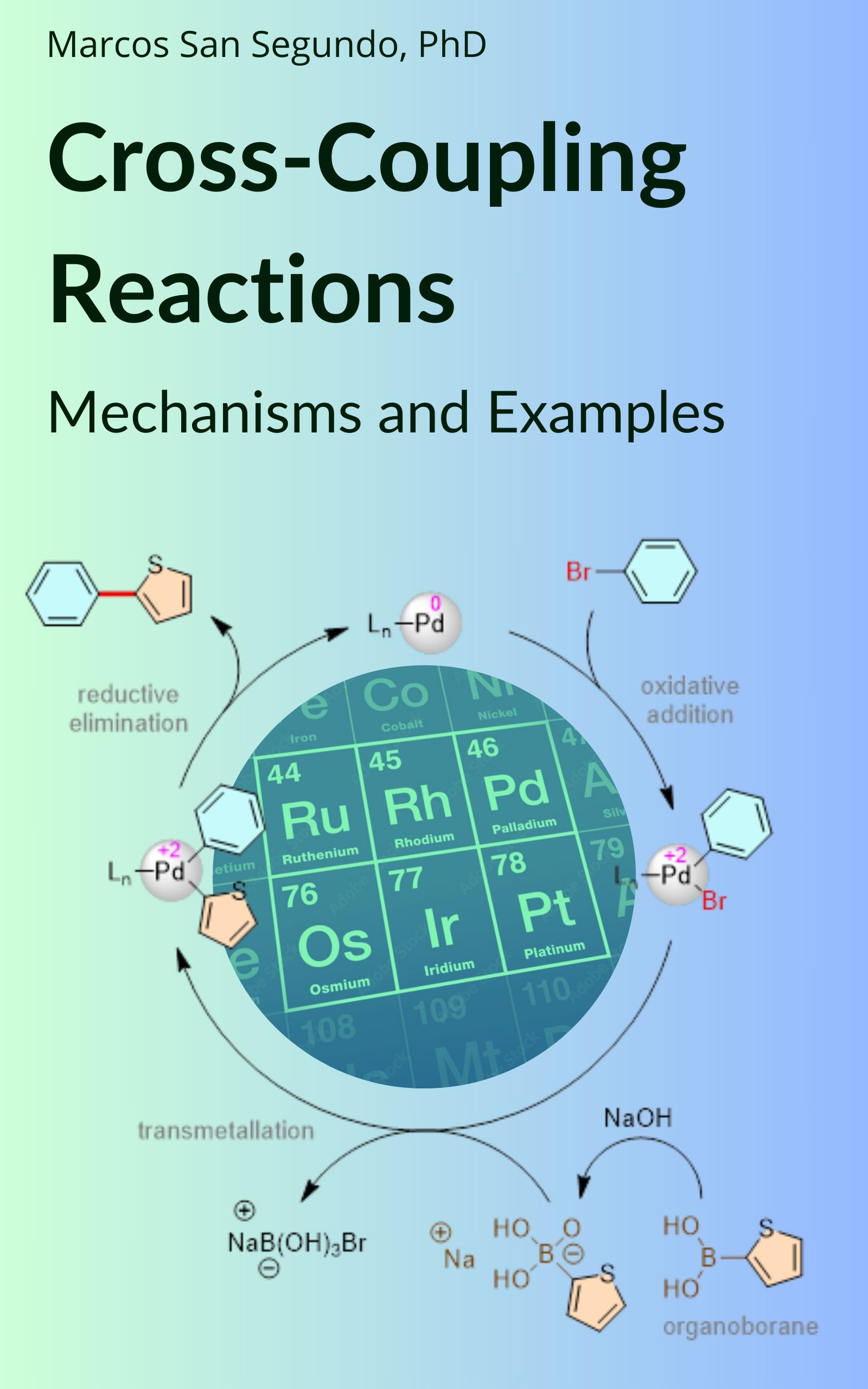
Cross-Coupling Reactions: Mechanisms and Examples
This page covers the Carbonylative Stille Coupling — one of 21 named reactions in the book, each with its full catalytic cycle and every worked example shown here, drawn straight from the primary literature.