Cadiot-Chodkiewicz Coupling
Cu(I)-catalyzed unsymmetrical diyne synthesis
What is the Cadiot-Chodkiewicz Coupling?
The Cadiot-Chodkiewicz coupling joins a terminal alkyne and a 1-bromo- or 1-iodoalkyne to give an unsymmetrical 1,3-diyne — a connection that is hard to make selectively any other way, since the obvious alternative (oxidative homocoupling) statistically gives a mixture of both symmetrical diynes alongside the desired cross product.
Selectivity comes from using a haloalkyne as the electrophilic partner instead of a second terminal alkyne: only the terminal alkyne needs to be converted to its copper(I) acetylide, and that acetylide reacts preferentially with the pre-activated C–halogen bond of the haloalkyne rather than with more of itself. A small amount of hydroxylamine or hydrazine is normally added to keep the copper catalyst in the Cu(I) state and suppress the competing Glaser-type homocoupling.
Reaction schemes


Catalytic cycle
Acetylide formation
The terminal alkyne is deprotonated and bound as a copper(I) acetylide, Cu–C≡C–R.
Oxidative addition
The copper acetylide reacts with the 1-haloalkyne at copper.
Reductive elimination
The two alkynyl fragments couple to give the unsymmetrical diyne and regenerate Cu(I).
Applications
- Synthesis of natural polyynes and conjugated diyne/enediyne natural products.
- Building blocks for molecular wires and rigid-rod materials.
- A cleaner alternative to homocoupling when only one specific diyne regiochemistry is wanted.
Worked examples
Every example below — reagents, conditions, and literature source — is reproduced from Cross-Coupling Reactions: Mechanisms and Examples by Marcos San Segundo, PhD.


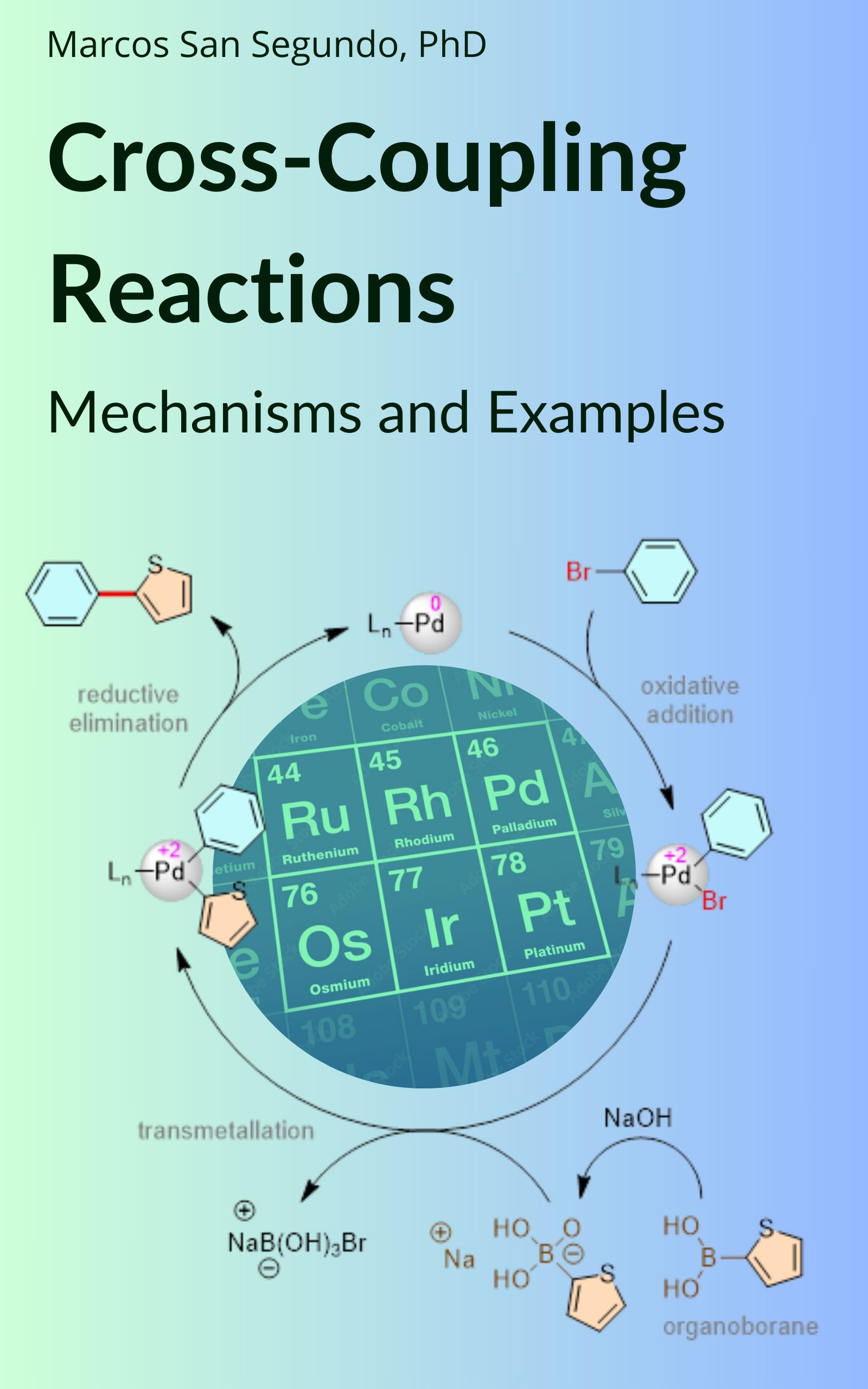
Cross-Coupling Reactions: Mechanisms and Examples
This page covers the Cadiot-Chodkiewicz Coupling — one of 21 named reactions in the book, each with its full catalytic cycle and every worked example shown here, drawn straight from the primary literature.